Category Archives: History

The Church and the Chaplain (1952)
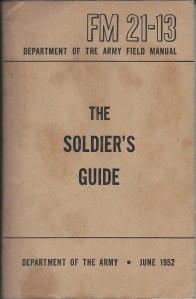 “The Army recognizes the importance of religion in the American way of life and in your training as a soldier. For that reason, a complete program of religious training is provided for soldiers of the three general faiths, Catholic, Jewish and Protestant. This program for the spiritual and moral welfare of the soldier is the responsibility of the commanding officer and is carried out through the chaplain assigned to the unit Chaplains advise commanders in religious matters and work directly with soldiers in helping them solve their problems. The chaplains have volunteered for this duty and it is their desire to be of the greatest possible service to soldiers and their dependents. Separate religious services usually are conducted for members of the three faiths, but it is sometimes impossible to conduct a separate service for each group. When this is the case, a general religious worship service is held. Attendance at these services is, of course, entirely a personal matter, but if you participate, you will find them a source of inner strength and your job as a soldier will be made easier.
“If your church requires that you attend services of your denomination, see your unit chaplain and he may be able to direct you to a chaplain of your faith in the area, or to a church of your faith in a nearby community.
“Available to you also are other religious activities such as Sunday school classes, Bible study classes, Holy Name Societies, and the Serviceman’s Christian League.
“Remember that the chaplain is always available to help you as a personal counselor. He will be happy to talk to you about any personal problem and will try to help you find a solution. Anything you tell him is confidential and privileged. This means tha the cannot be required to repeat anything you have told him. The chaplain will visit soldiers in the guardhouse or hospital, and you may call upon him to conduct religious services such as baptisms and weddings.
“It is customary to address these officers as ‘Chaplain,’ but Catholic chaplain may prefer to be called ‘Father’; Jewish chaplains may prefer to be called ‘Rabbi’; and Protestant chaplains sometimes prefer to be called ‘Reverend.”
.
.
Taken from FM 21-13, “The Soldier’s Guide,” Department of the Army, June 1952 (author’s collection).
.
.

Dedication of the Tomb of the Unknown Soldier, 11 November 1921
As Veteran’s Day 2017 comes to a close, here’s a brief look back 96 years to Armistice Day, 11 November 1921, when Chaplain John T. Axton (then the Army Chief Chaplain) committed the body of an unknown WW1 Soldier, dedicating the Tomb of the Unknown Soldier at Arlington National Cemetery.

Chaplain (COL) John T. Axton commitments the body of an unknown Soldier at Arlington National Cemetery, 21 November 1921 (author’s collection).
Three years after the end of World War 1, an unidentified Soldier who had been killed in fighting in France during the war was brought to Washington D.C. and lay in state in the Capitol Rotunda until 11 November 1921. On this Armistice day, the body of the unknown Soldier was committed and interred outside the Memorial Amphitheater at Arlington National Cemetery, along with the dedication of the Tomb of the Unknown Soldier.
Read the rest of this story (along with more pictures) here.
.
.

“Doubly So When Wars Increase”
Living, working and playing among the Service Members they minister to, chaplains usually have insight into the struggles and feelings of those Service Members. They help them try to navigate their troubles successfully through many means, based on their strengths and talents. Some use poetry, as did Chaplain Henry W. Habel, who by March 1945, had been an Army Chaplain for three years.
Chaplain Habel was from Buffalo, New York and graduated from Acadia University in Nova Scotia before pastoring churches in Kentucky, Pennsylvania, New York and Canada through the Baptist Church of the Northern Convention.
The following poem, written by Chaplain Habel, was found in a worship bulletin from 6 May 1945, from the 13th General Hospital Chapel in New Guinea where Chaplain (Major) D.O. Luginbill and Chaplain (Captain) L.V. Walters were the chaplains.
.
Our Worship
Oft men feel they’re “in a spot”,
Wondering how to bear their lot,
Grieving that there must be change;
“Why?” they ask. “Tis all so strange!”
Such the case in time of peace;
Doubly so when wars increase.
Yearning hearts cry every where,
Weighed with this most awful care.
Here’s a truth. Grasp it with me.
Change is a necessity!
Through it better days are born,
Life made wholesome while it’s torn.
Hardships build a stronger man,
Vision full, a will that can,
Satisfied with simple things,
Fighting all that evil brings.
.
.

“Ills, Ails and Wails…” (TS Cards)
There are several variations of the “TS” card seen around from years past. I’ve seen these spelled out as “Tuff Stuff” or “Tuff S**t” but both were a humorous way to discourage whining. Likely begun as a joke to give to Service Members who seemed to complain all the time, similar to the phrase, “tell it to the chaplain” instead of listening to the gripe. Most have a number of boxes that can be checked off or hole-punched, to indicate the number of visits to the chaplain (I’m not sure if the chaplain would no longer see that Service Member whose card got full!).
It seems that some chaplains picked up on these and used similar cards, perhaps the ones with “Tuff Stuff” instead of the alternative, then later “Theological Solutions,” to encourage Service Members to come and see them and also to advertise worship services. Below is a card used by chaplains at Spokane Army Air Field (sometime between the end of WW2 and 1950) which has similar encouragement to visit the chaplain on one side (with places for hole-punches) and worship service times on the other side for Catholics, Protestants and Jewish Service Members (author’s collection):


.
Below is another similar TS card, this using the TS to recommend “Tried Solutions for Tough Situations” with several situations paired with Scripture verses. This card also has the blocks around the outside to be hole-punched by the chaplain. On the reverse is a picture of the chaplain, Melvin E. Pratt (author’s collection):


.
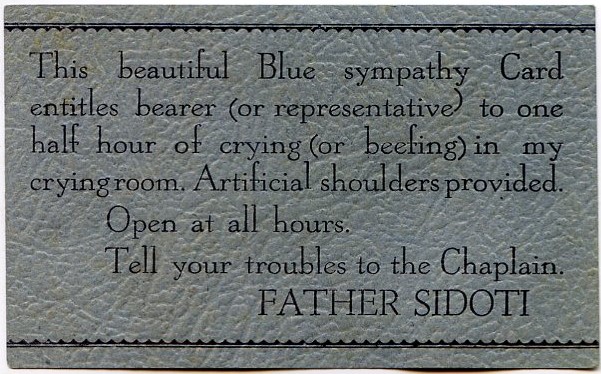
Below is a simpler “TS” card adding the common statement, “Tell your troubles to the Chaplain” by Chaplain Sidoti, who had a distinguished military career in WW2 and following in the NY National Guard. You can read more about Chaplain Sidoti here (author’s collection):
.
Interestingly, but not surprisingly, the Army Chief of Chaplain’s office was not thrilled with chaplains’ use of these TS cards. In Circular Letter 293, 1 February 1945, the following admonition was given:
T.S. Cards: It has recently come to the attention of this office that some chaplains are still resorting to the use of the so called “T.S. Card.” It is believed that such a practice does not reflect favorably upon the chaplains involved or the Corps in general. It is our duty to serve with proper dignity all men who come to us irrespective of the validity of their complaints. The possibility that even a few may take offense at what would appear to be harmless humor lessons our opportunity for service and prevents us from performing as well as possible the duties for which the Army has commissioned us. (Source: Chaplain Bob Nay)
.
.

Make 1944 a Record Year!
Chaplains have always found ways to remind their Soldiers, Sailors, Marines or Airmen about worship services. During WW2, one chaplain used these “Greeting” cards with a calendar to encourage attendance.
Likely distributed by the chaplain around Christmas 1943, this folded card includes a couple of verses and an invitation to attend Chapel Services. There is also an invitation to see the chaplain with any problems the Soldier may have. The inside includes a 1944 calendar to check off Sunday worship attendance as well as communion participation with the encouragement to “make 1944 a record year” and is pre-signed by the chaplain, Gilbert Johnstone (author’s collection).


.
.
You can see more items that chaplains gave to Service Members on this page.

Consider the Call…
In 2007, the Army Chaplain Corps ran a series of ads that appeared at least in Army Times, in an effort to encourage people “already ordained or still in seminary” to “consider the call of a truly unique ministry.” I’ve recently come across two of these ads from September and October 2007 issues of Army Times. Have you considered the call?
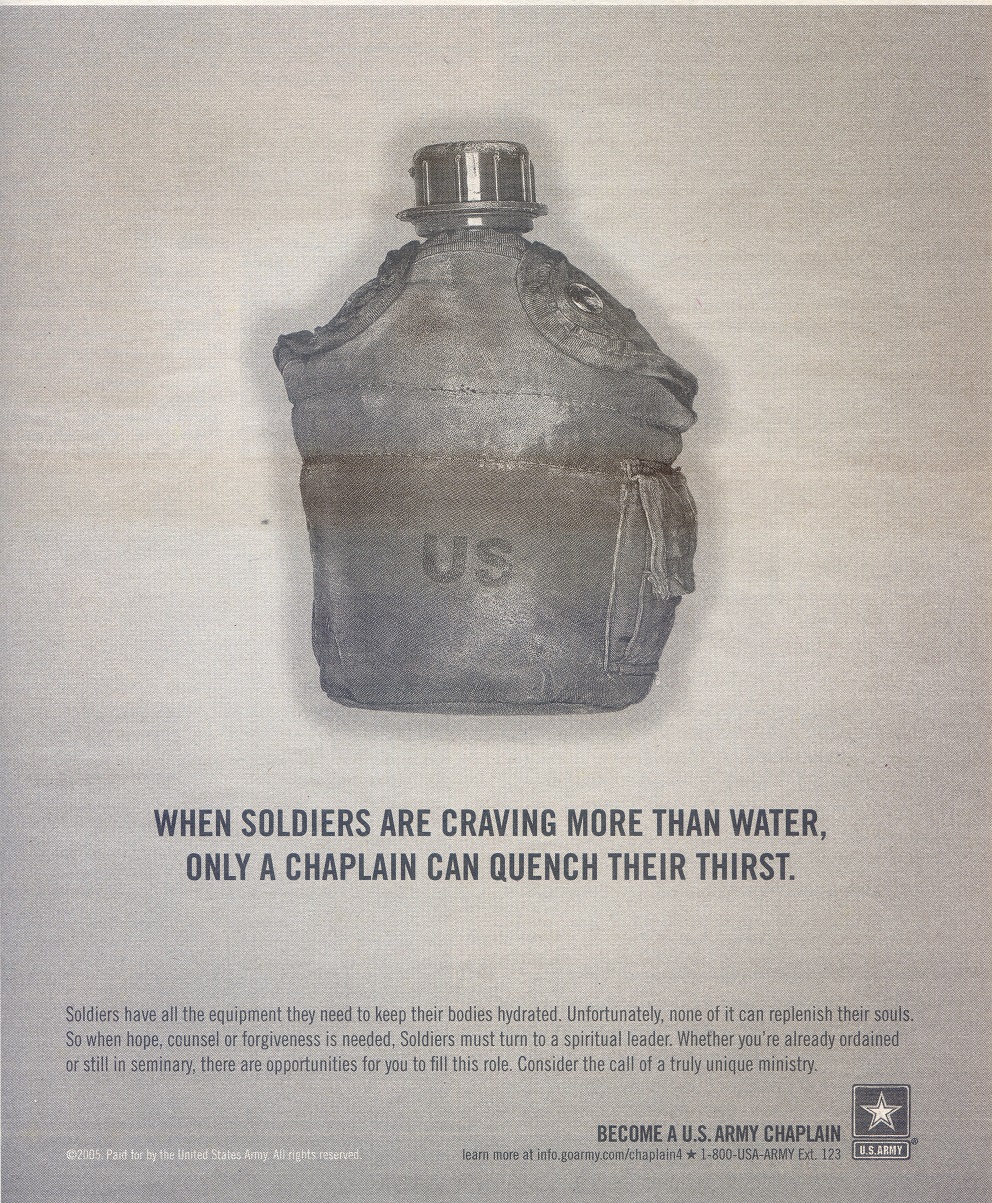
Army Chaplain recruiting ad from Army Times, 10 September 2007 (author’s collection).
.
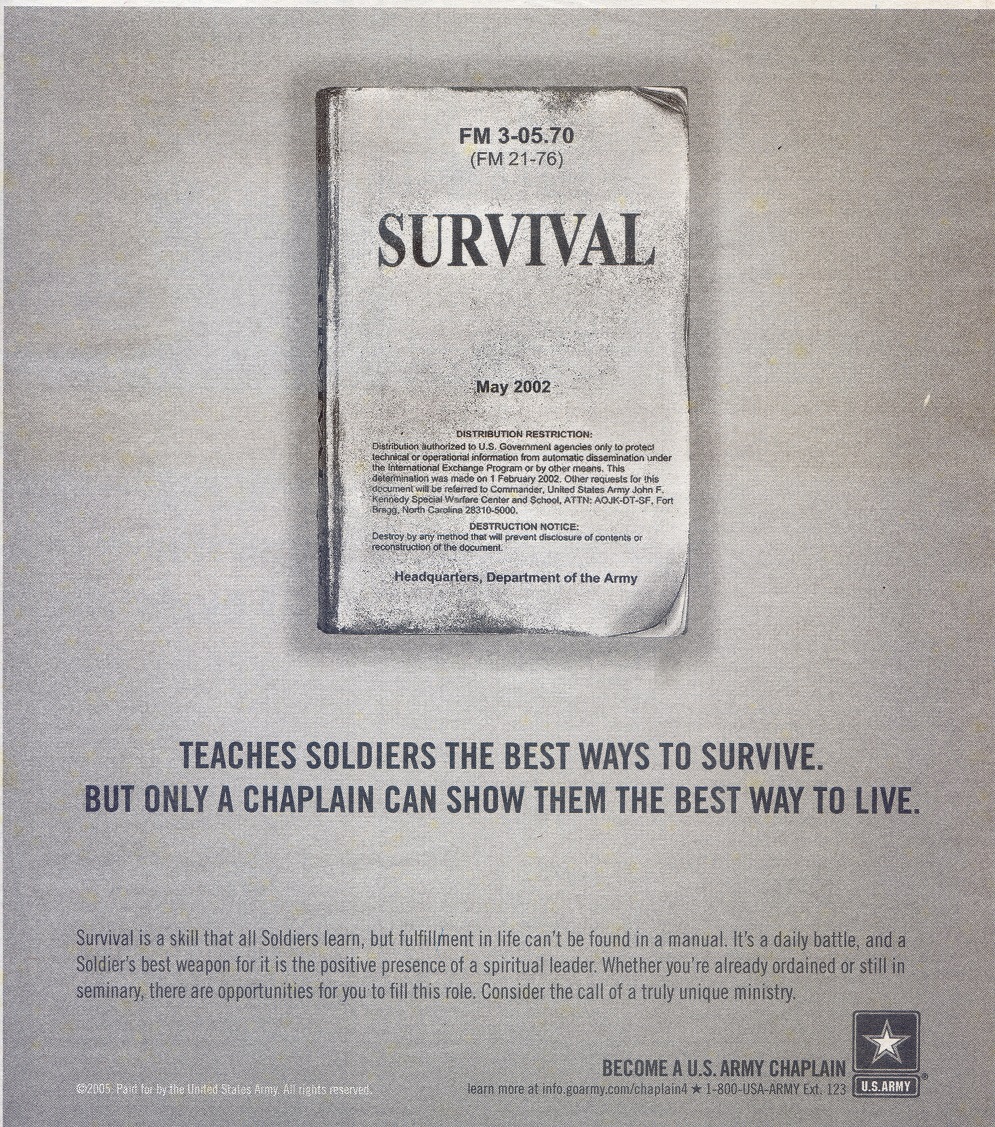
Army Chaplain recruiting ad from Army Times, 29 October 2007 (author’s collection).
.
.

“Four Chaplains” Ballad Sung by Fred Neil
I recently came across a radio single of “Four Chaplains,” a song that is not very familiar to many. The words and music are by R. Alfred and W. Gold. It was performed by Fred Neil and released as a single in 1960. It also appears on the album, Trav’lin Man: The Early Singles (2008). This is a ballad about the four World War Two chaplains who gave up their lives as they gave away their life jackets to other Soldiers after the USS Dorchester, which they were being transported on, was attacked by a German submarine (digitalized from a “Radio Station Copy,” author’s collection).
.
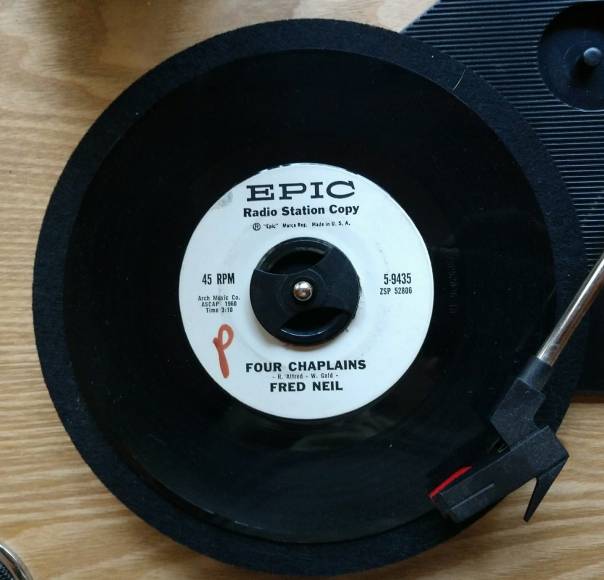
Radio Station Copy of “Four Chaplains” performed by Fred Neil (author’s collection).
.
You can read more about the Four Chaplains on this site at History > Chaplain Stories > The Four Chaplains.
.
.



When the Flag Must Yield
According to United States Code (U.S.C.) Title 4, §7, (c) “No other flag or pennant should be placed above or, if on the same level, to the right of the flag of the United States of America…” This law reserves the place of honor to the national flag while on U.S. soil, territories, military bases, ships, etc. (with exception granted to the headquarters of the United Nations in New York).
Most Americans know this law even if they don’t know where to find it. Its intent is to prescribe the prominence of the symbol of the United States over that of “States, cities, … localities, or … societies.” It is this law that defines the order of placement of flags when flown in front of buildings, on staffs inside churches and other buildings, even while carried in parades.
What most people don’t know however, is that there is a notable exception written into federal law. An exception that permits one thing -one pennant- to fly in the place of prominence above the flag of the United States. This law essentially permits the emblem of the United States of America to yield prominence to something else.
The flag of the United States yields only to church services aboard Navy vessels.
According to U.S.C. approved by Congress on 2 June 1942 the United States flag flies above any other flag or pennant “except during church services conducted by naval chaplains at sea, when the church pennant may be flown above the flag during church services for the personnel of the Navy.”
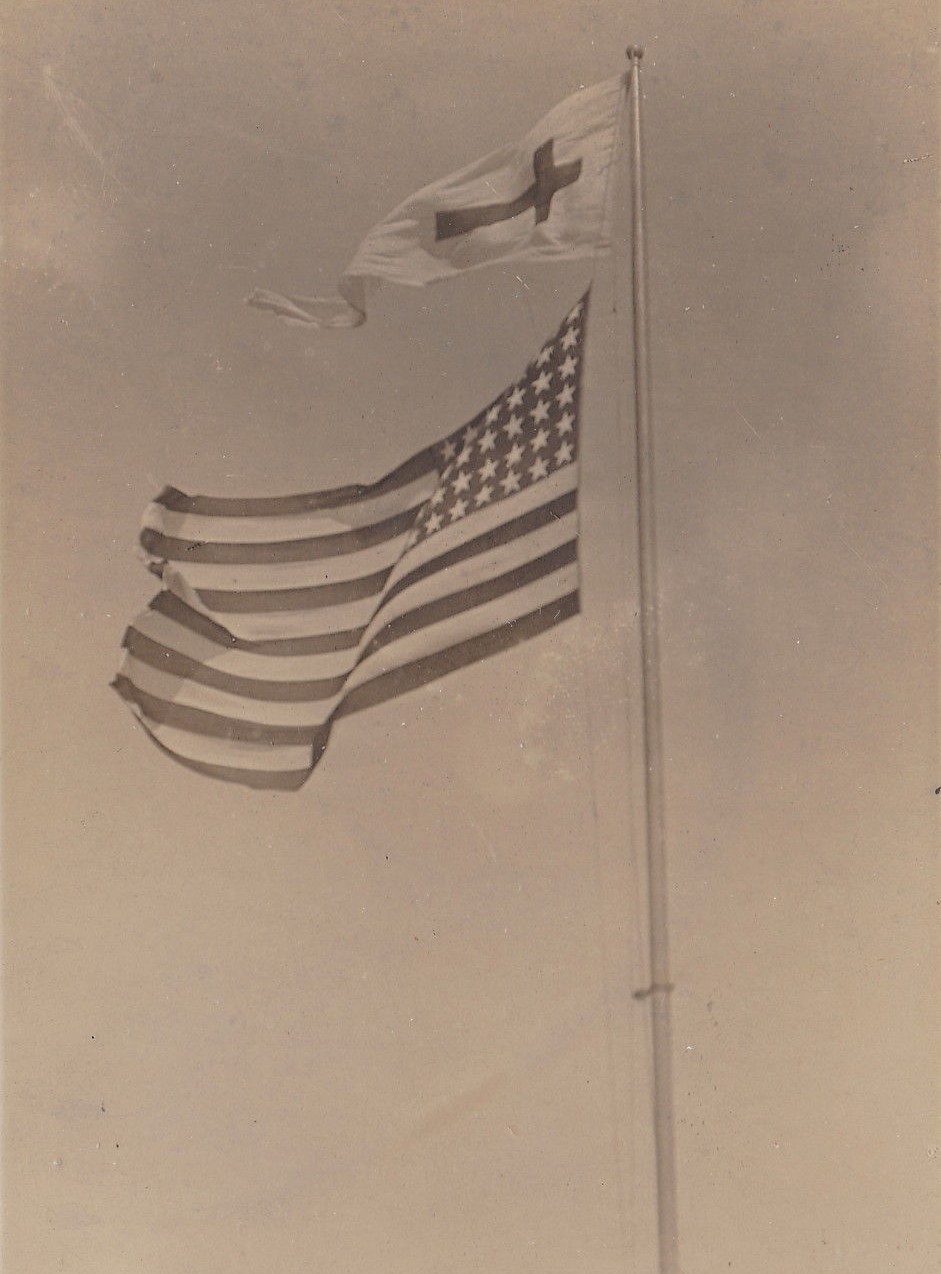 Early on, the flying of the “church pennant” above the national flag was simply Navy tradition used “as a signal by ships at sea to denote to other ships that Divine Service is being held on board the vessel where the pennant flies.”1
This tradition wasn’t looked on with favor by everyone. In 1923 a group of patriotic organizations met at a conference in Washington, D.C. to formulate and recommend law for the proper presentation and treatment of the flag of the United States. The members of this conference “looked with disfavor upon the Navy custom of hoisting the church pennant over the national emblem as a signal the Divine Services were in progress.”2
Not only by this conference, but disapproval was also expressed by some Congressmen. In years following, the Secretary of the Navy was even called before Congress to answer whether any pennant flew above “the Stars and Stripes” on Naval vessels.3
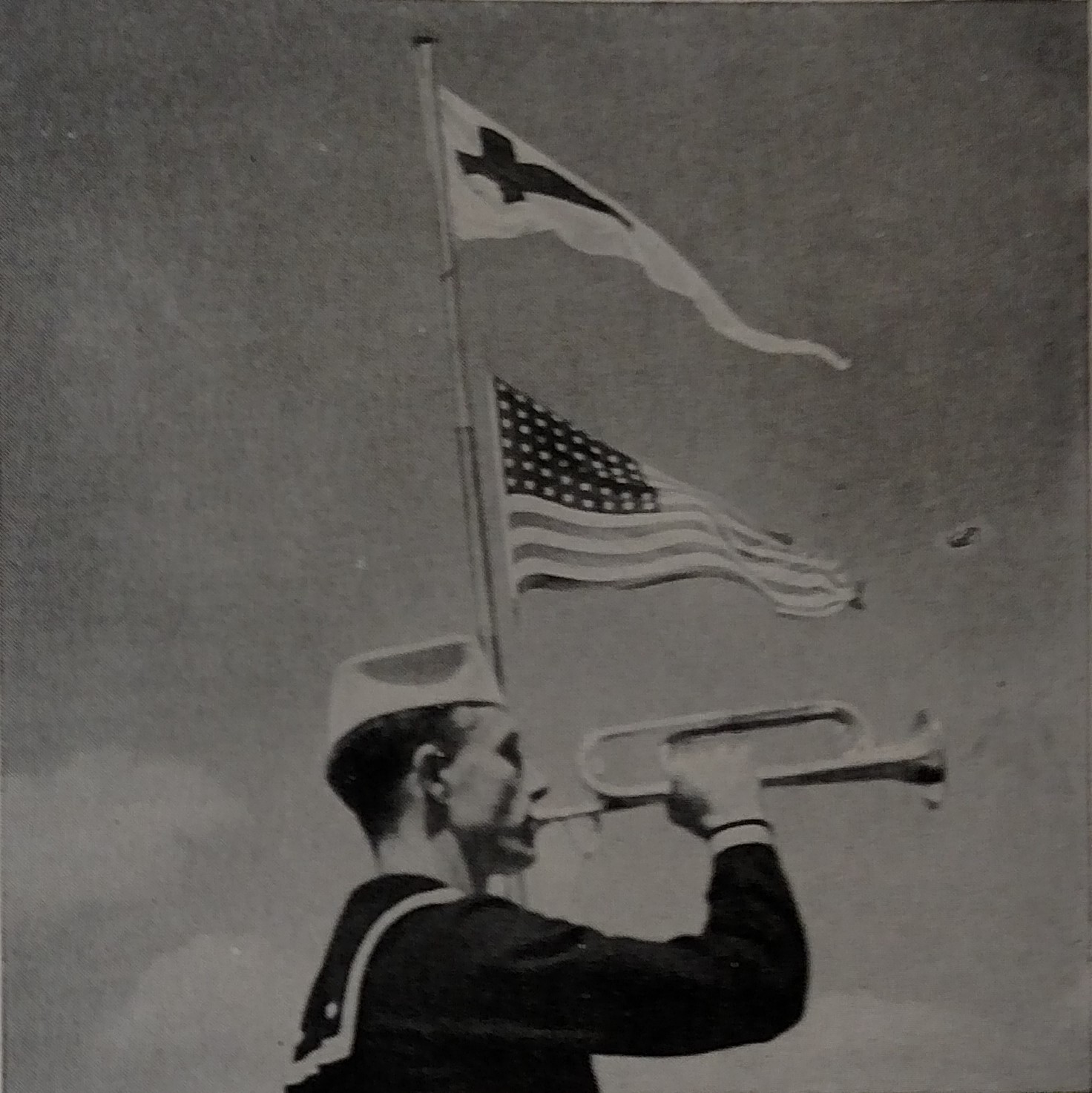 As the United States entered World War II however, with the extreme support given to the military services and their members during times of war, the practice was codified into U.S. law to permit this Navy tradition to continue, as it does to this day. According to Jonathon Maloney, a Navy Chaplain at sea as of the time this writing, the church pennant is flown above the national colors “every Sunday when I am holding services on Ship.”4
So by federal law, this one exception exists that places the identification of the presence of the chaplain and the performance of worship above the emblem of the United States of America.
.
.
.
1Clifford Merrell Drury, “The History of the Chaplain Corps, United States Navy, Vol. 2, 1939-1949.” NAVPERS 15808, pg. 123.
2 Clifford Murray Drury, “The History of the Chaplain Corps, United States Navy, Vol. 1, 1778-1931.” NAVPERS 15807, pg. 229.
3 Ibid.
4 Facebook Messaging conversation between author and Chaplain Jonathon Maloney, 30 September 2017.
.
.




 The Chaplain Kit