Category Archives: Chaplaincy

The Chaplain Corps’ Birthday
In 2001, Chaplain (MG) Gaylord T. Gunhus, then Army Chief of Chaplains, wrote this letter to chaplains and chaplain assistants, about the Chaplain Corps’ birthday on 29 July:
.
The Chaplain Corps’ Birthday
by Chaplain (MG) G.T. Gunhus, Chief of Chaplains
“We have come a long way since the Continental Congress officially established in 1775 the position of chaplain in the Continental Army. The stipend of $33 per month was established for the chaplains, an amount equal to the pay of a captain.
“During the Revolutionary War the Chaplaincy was a representation of the nation’s religious denominations: 90 Congregationalists, 41 Presbyterians, 20 Anglicans, 11 Baptists, two Lutherans and one Roman Catholic. Since that time, we have ministered to the soldiers and family members of the U.S. Army in war and peace. Our numbers have varied fro a very few in the 1800’s to a high of 8,117 chaplains in World War II.
“It wasn’t until 1914 that chaplains wore the official uniform of an Army officer. The original insignia, a shepherd’s crook, signified the pastoral role of the chaplain. The chaplain’s crook was replaced by a Latin Cross on May 31, 1898. It was authorized for use by all Protestant and Catholic Chaplains. During World War 1, when a large number of Jewish rabbis served in the Army, the Tablets of the Law, with the Star of David, was authorized for them. Those two insignia and the crescent surmounted with a star, the insignia for the Muslim chaplain, are the insignia which identify all of us today.
“Since the beginning of World War II, chaplains have been required to minister in combat unarmed. The signing of the Geneva Convention entitled chaplains to a noncombatant role and protected person status. However, of the 33 chaplains interned by the Japanese in the Philippines, 18 died and many of the survivors were beaten for attempting to invoke the Geneva Convention in an effort to minister to their soldiers. Also, during World War II, 124 chaplains were killed in action, in Korea 13 lost their lives, and 13 were killed in Vietnam.
“Connected to the heritage of the Army Chaplaincy is its history of creative ministry and appropriate pastoral care. The Army is a better institution in which to serve because the Unit Ministry Teams (UMTs) have continually delivered the message of hope and made practical applications to that message. The UMTs’ loan closets and the chaplains’ multifaceted counseling have become institutionalized in what is now known as Army Community Services. When commanders were troubled by problems of racism, rights of individuals, and drug and alcohol abuse, chaplains responded with programs that are now known as Equal Opportunity, Total Army Quality, and the Army Alcohol and Drug Abuse Prevention and Control Program. Today our Chaplain Family Life Centers set the pace for the Army Family Support Activities.
“The Army Chaplaincy is facing new challenges: reduced force, numerous deployments, reduced resources and the impact of those factors on the quality of life for the soldier and family members. As we celebrate the 226th Anniversary of the Army Chaplaincy, may we renew our call to the service of the Lord. May our pastoral care and ministry renew the spirit and soul of our soldiers and family members. May we bring hope and strength to all of those we serve. This is my prayer for you, for all the Army Chaplaincy and the people we serve.
“GOD BLESS YOU AND HAVE A GREAT DAY!”
.
.
From a letter to Lutheran chaplains from Chaplain Stake dated 19 August 2001, from the personal chaplain papers of Chaplain Paul Howe (TCK Archives).
.
.

22 July 1864: Chaplain Haney takes up arms and earns the MoH
 “Chaplain Milton L. Haney was awarded the Medal of Honor on November 3, 1896. It was awarded for his actions during the Battle of Atlanta at Peachtree Creek on July 22, 1864. Four men earned the medal of Honor that day, and among those four was Milton Haney, sometimes called “The Fighting Chaplain” by the men of the 55th Illinois Infantry.”1
“When the tide of the battle was critical on July 22, Chaplain Haney voluntarily took up a musket and joined the ranks of his regiment, fighting with his men in retaking the Union works that had previously fallen to enemy forces.”2 “Milton Haney was awarded the Medal of Honor for conspicuous gallantry in a federal counterattack during fierce fighting outside Atlanta.”3
Haney “was born at Savannah, OH on January 23, 1825, and he died at Altadena, CA on January 20, 1922 at the age of 96. He is buried in the Mountain View Cemetery.”4
.
.
.
.
1 Chaplain Regimental Museum Association’s Facebook page.
2 Ibid.
3 Herman A. Norton, “Struggling for Recognition: The United States Army Chaplaincy, 1791-1865.” Washington, D.C.: Office of the Chief of Chaplains, Department of the Army, 1977.
4 Chaplain Regimental Museum Association’s Facebook page.
.
.

Learning from Chaplain Kapaun
About 70 years ago (25 June 1950) the conflict in Korea began as North Korean forces invaded the south. One of the first American units to arrive in Korea was the 8th Cavalry, and one of their chaplains was Emil Kapaun. Here’s a little bit of his story and an encouragement to follow his example.
.
.
.

The Chaplain’s Job During the Mexican Border War
It is interesting how this chaplain, in 1915, was searching for the best way to do his job while struggling with some of the things that chaplains still struggle with today. It is an interesting look into the life of a chaplain from early last century, deployed with his soldiers.
The Chaplain’s Job
by John M. Thomas
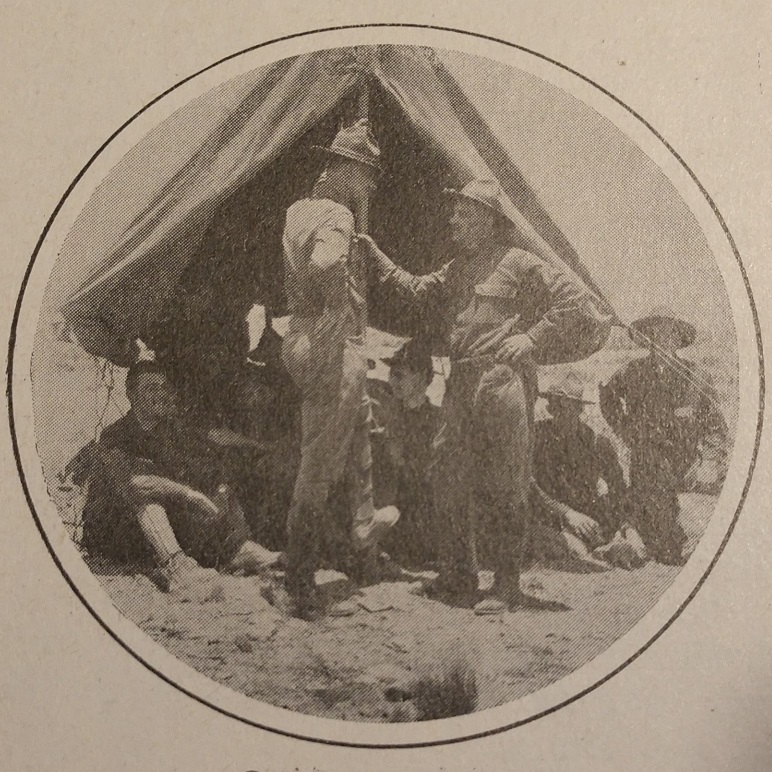
“Tent Talk (International Film)”
“I did not hold a regimental church. The army has a bugle call for ‘church,’ plaintive, soft, and very beautiful, and some chaplains console themselves for handful audiences by imaginations of mysterious influences supposed to proceed from the mere sounding of the church I wanted something more tangible. So I had a motor truck driven into a company street every Sunday evening and the entire regiment assembled in regular formation before it…
.
Continue reading this story at The Chaplain’s Job…

Why is Memorial Day Important?
As a nation who cherishes its freedom, Memorial Day should be one of the most significant of holidays as we honor those who have fallen in defense of the freedoms we cherish. Here is a brief video with a summary of the history of Memorial Day and an encouragement to remember those who died for our freedom.
.
.
.

It Could Be Worse… (Part 2)
It may be difficult not gathering for worship together during the COVID-19 pandemic, but just think, you could be gathering for worship in a barn … away from home … using a portable pump organ … in a combat zone!
The caption to this U.S. Army photograph dated 1944 reads:
Artillerymen attached to an Armored Unit attend Protestant Services held in a barn near France.
.
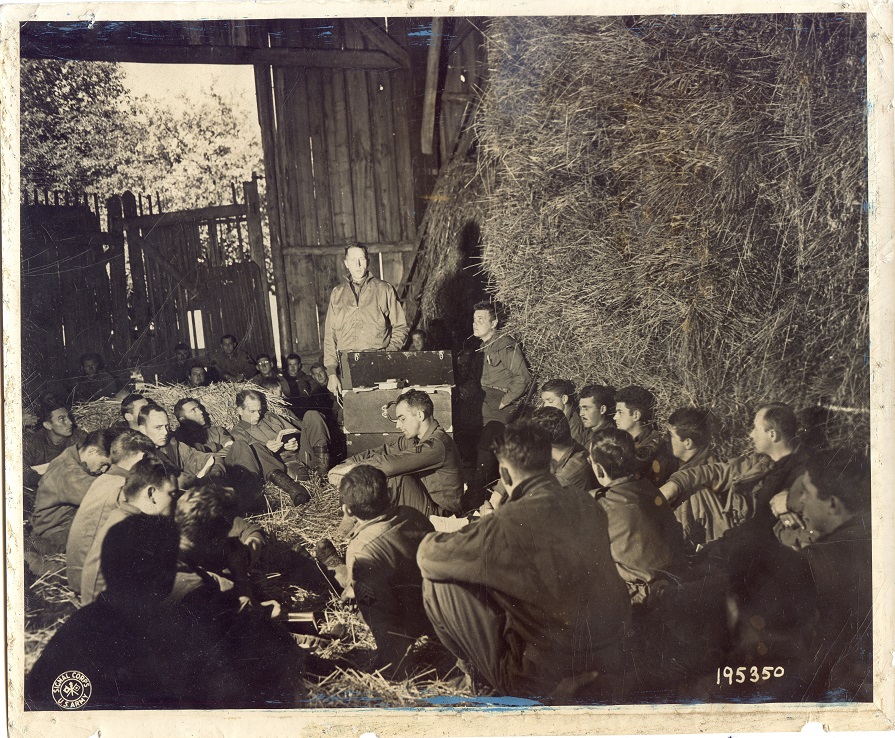
U.S. Army Signal Corps Photo, ETO-HQ-44-17550 (TCK Archives)
.
.

It Could Be Worse…
It may be difficult not gathering for worship together during the COVID-19 pandemic, but just think, you could be gathering for worship outside … in the snow … in the cold … in Alaska!
The caption to this U.S. Army photograph dated 31 January 1955 reads:
Time Out for Worship at Camp
Using a Jeep as improvised altar, Chaplain (Maj.) Joseph M. Mollner, chaplain of the 53d Infantry, celebrates Roman Catholic mass during Exercise Snowbird. Troops of the 53d have established base camp near Caswell, Alaska, and they will act as ‘aggressor’ forces during second phase of the maneuvers.
.

Photo by PVT Vial, Fort Richardson, Alaska, 31 Jan 1955 (TCK Archives).
.
.

Not COVID-19, but Combat, Disrupted Worship Services in Vietnam
Due to the COVID-19 Pandemic, many chaplains today have been shuffling their routines and procedures to produce video devotionals and online worship services for their parishioners to receive religious support while many who are deployed shuffle their schedules to accommodate military operations. Here is a press photo, taken 4 April 1966, of Army Chaplain Curtis Bowers with such an experience. The caption reads:
.
Chaplain Curtis Bowers of Lancaster, Pa., sometimes has to change his schedule of services. Protestant services for the U.S. 101st Reconnaissance Platoon, the ‘Screaming Eagles,’ were held last week on Monday near Tuy Hoa, South Viet Nam, because the men had fought all day Sunday.
.
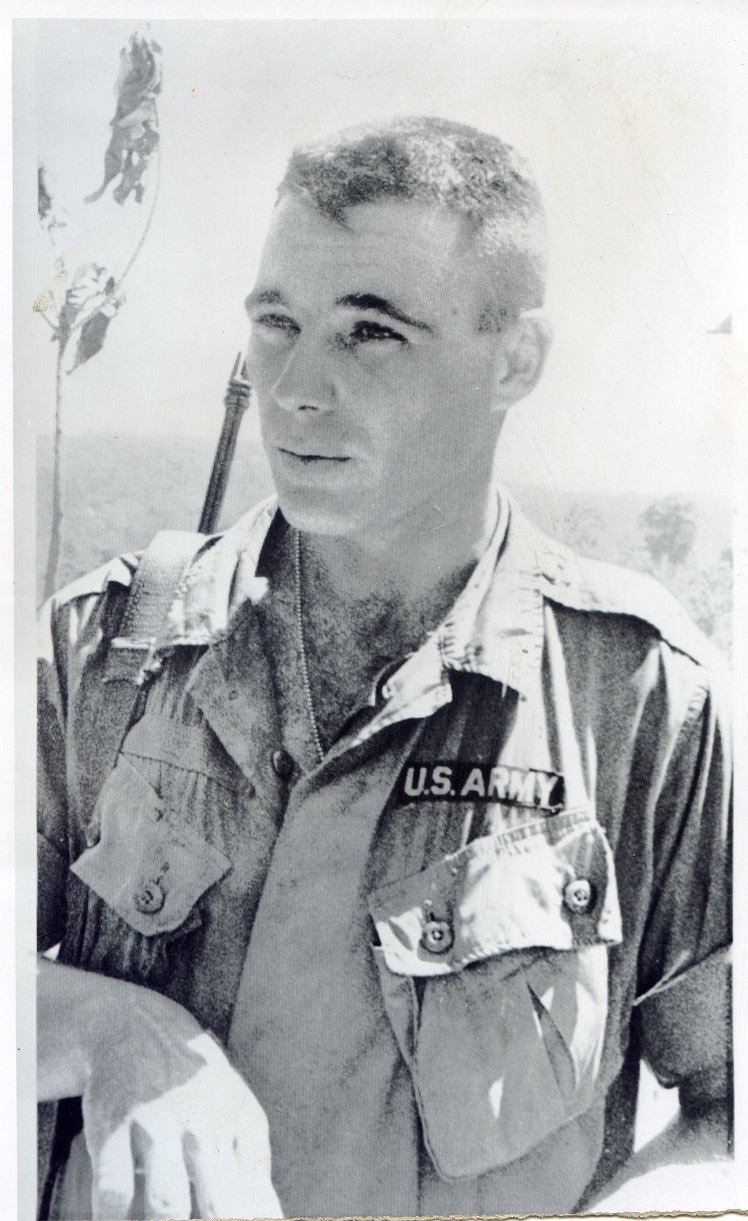
AP Photo, 4 April 1966, Chaplain Curtis Bowers (TCK Archives)
.
.

Presidents Day Reminder
For Presidents Day, remembering George Washington and his chaplain. Washington was arguably the President who most supported military chaplaincy, being instrumental in Congress approving chaplains for the Continental Army during the Revolutionary War.
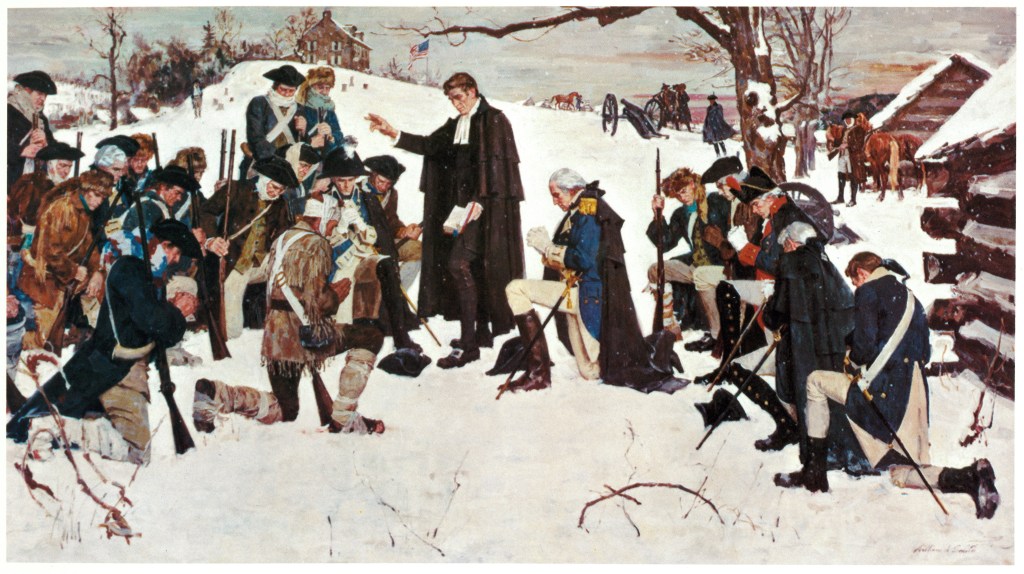
“The Chaplain at Valley Forge (artist: William A. Smith). History records that our first commander-in-chief was a man of sincere religious faith. He depended heavily upon the chaplains of the Continental Army for their spiritual and moral leadership. Israel Evans was sometimes referred to as ‘General George Washington’s Chaplain.’ He led the Army in prayers at Valley Forge. Before a battle, he usually prayed that the Lord of Hosts would lead the Army to victory, if that be according to Divine Will; if not, he begged God to stand neutral and let ‘flesh and blood’ decide the issue”

The Five Chaplains of the SS Mallory
7 February 1943 proved to be one of the deadliest days of combat for Army chaplains during World War Two. The U.S. Army Chaplain Corps reported the following chaplain deaths occurred on that day: Chaplain (1LT) Horace E. Gravely, Chaplain (1LT) James M. Liston, Chaplain (CPT) Ernest W. MacDonald, Chaplain (1LT) Valmore G. Savignac, and Chaplain (CPT) David H. Youngdahl.1 These five chaplains all died in the attack on the S.S. Henry R. Mallory while being transported through the North Atlantic to their next wartime assignments.
Before departing on the Mallory many, if not all, of the chaplains who would be traveling together got to know each other, as well as the four famous chaplains who would later die when the U.S.A.T. Dorchester was sunk just a few days before the Mallory experienced the same fate.
.
.
.




 The Chaplain Kit