Author Archives: Daryl Densford

When the Flag Must Yield
According to United States Code (U.S.C.) Title 4, §7, (c) “No other flag or pennant should be placed above or, if on the same level, to the right of the flag of the United States of America…” This law reserves the place of honor to the national flag while on U.S. soil, territories, military bases, ships, etc. (with exception granted to the headquarters of the United Nations in New York).
Most Americans know this law even if they don’t know where to find it. Its intent is to prescribe the prominence of the symbol of the United States over that of “States, cities, … localities, or … societies.” It is this law that defines the order of placement of flags when flown in front of buildings, on staffs inside churches and other buildings, even while carried in parades.
What most people don’t know however, is that there is a notable exception written into federal law. An exception that permits one thing -one pennant- to fly in the place of prominence above the flag of the United States. This law essentially permits the emblem of the United States of America to yield prominence to something else.
The flag of the United States yields only to church services aboard Navy vessels.
According to U.S.C. approved by Congress on 2 June 1942 the United States flag flies above any other flag or pennant “except during church services conducted by naval chaplains at sea, when the church pennant may be flown above the flag during church services for the personnel of the Navy.”
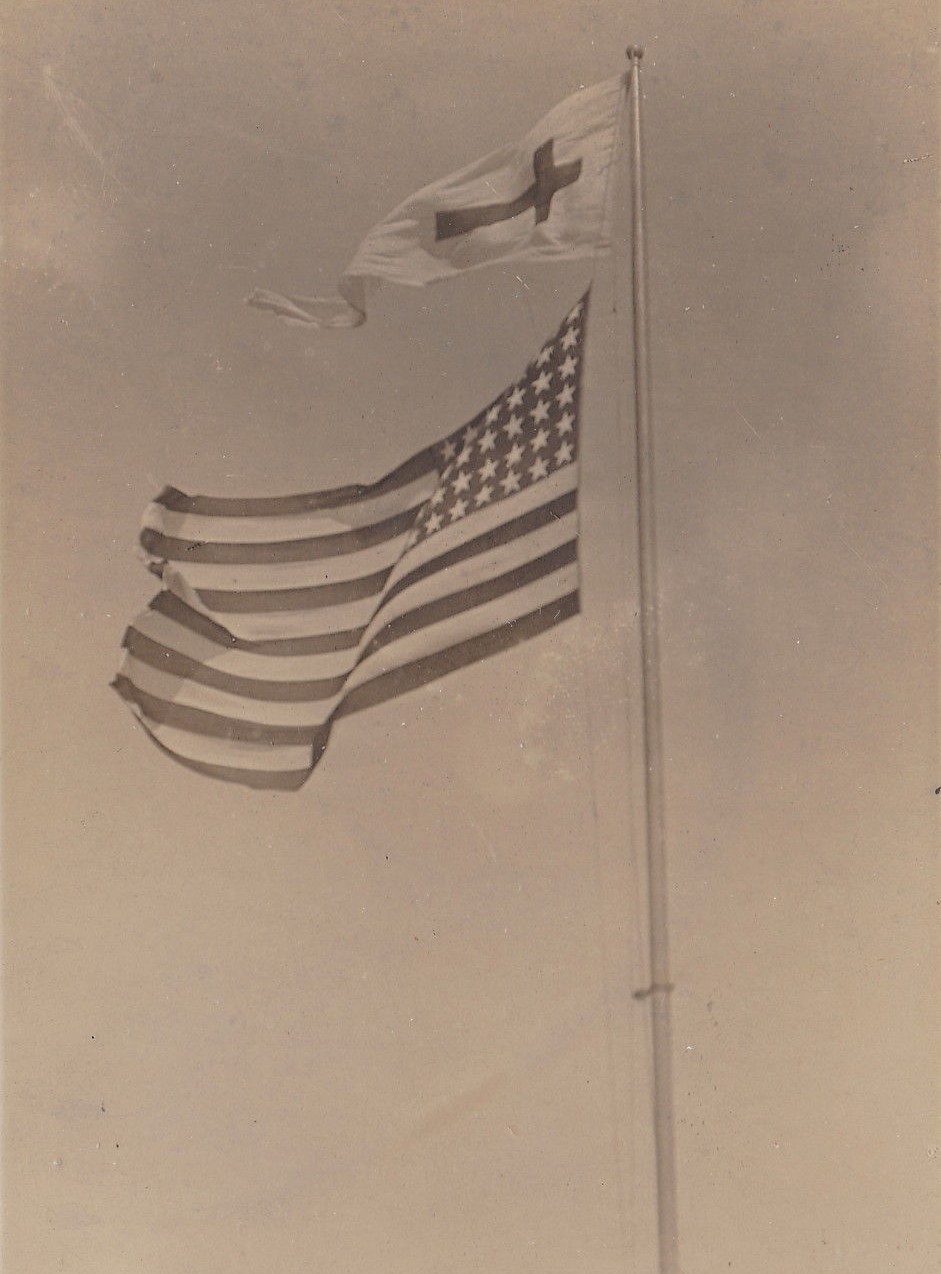 Early on, the flying of the “church pennant” above the national flag was simply Navy tradition used “as a signal by ships at sea to denote to other ships that Divine Service is being held on board the vessel where the pennant flies.”1
This tradition wasn’t looked on with favor by everyone. In 1923 a group of patriotic organizations met at a conference in Washington, D.C. to formulate and recommend law for the proper presentation and treatment of the flag of the United States. The members of this conference “looked with disfavor upon the Navy custom of hoisting the church pennant over the national emblem as a signal the Divine Services were in progress.”2
Not only by this conference, but disapproval was also expressed by some Congressmen. In years following, the Secretary of the Navy was even called before Congress to answer whether any pennant flew above “the Stars and Stripes” on Naval vessels.3
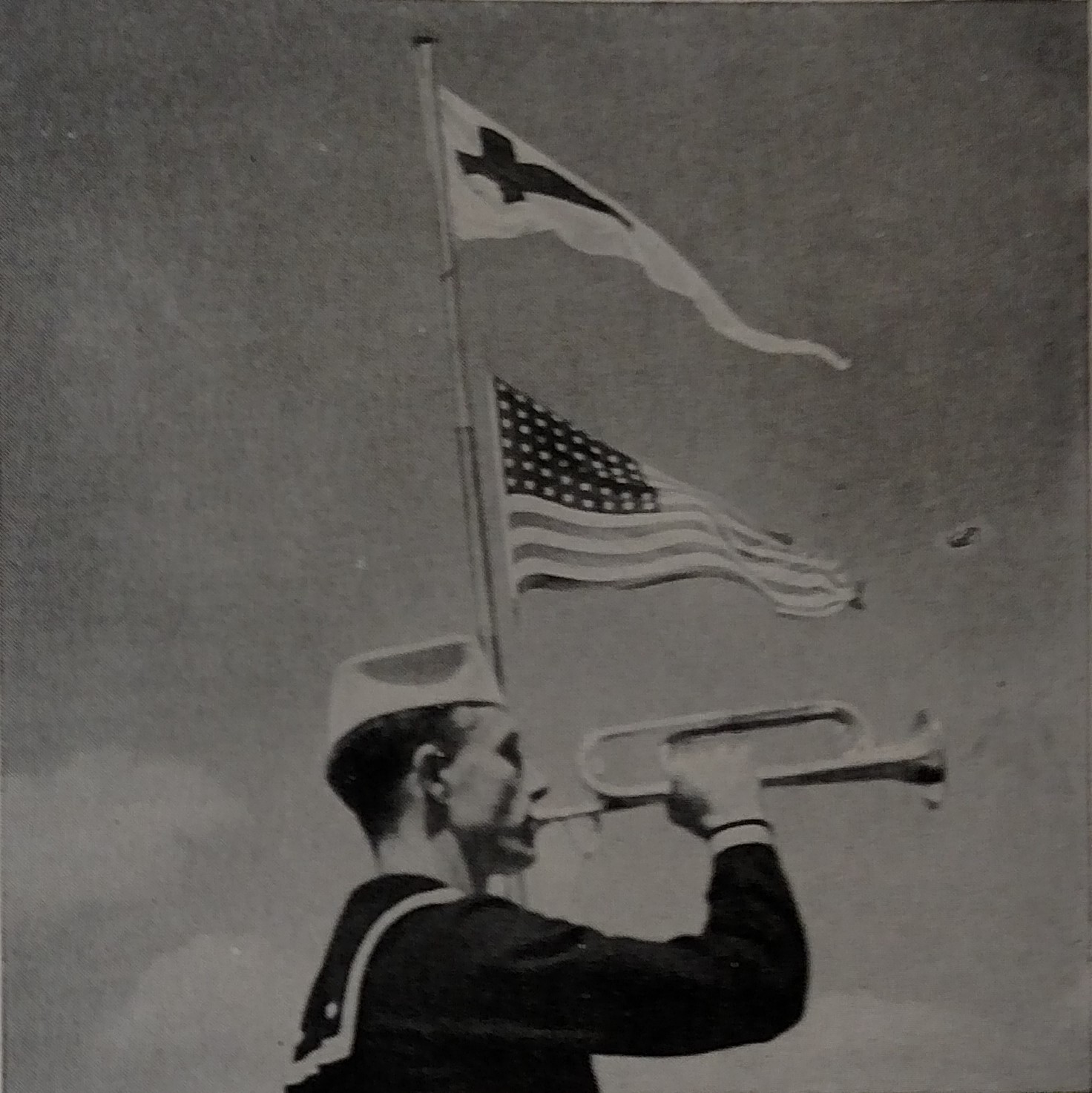 As the United States entered World War II however, with the extreme support given to the military services and their members during times of war, the practice was codified into U.S. law to permit this Navy tradition to continue, as it does to this day. According to Jonathon Maloney, a Navy Chaplain at sea as of the time this writing, the church pennant is flown above the national colors “every Sunday when I am holding services on Ship.”4
So by federal law, this one exception exists that places the identification of the presence of the chaplain and the performance of worship above the emblem of the United States of America.
.
.
.
1Clifford Merrell Drury, “The History of the Chaplain Corps, United States Navy, Vol. 2, 1939-1949.” NAVPERS 15808, pg. 123.
2 Clifford Murray Drury, “The History of the Chaplain Corps, United States Navy, Vol. 1, 1778-1931.” NAVPERS 15807, pg. 229.
3 Ibid.
4 Facebook Messaging conversation between author and Chaplain Jonathon Maloney, 30 September 2017.
.
.

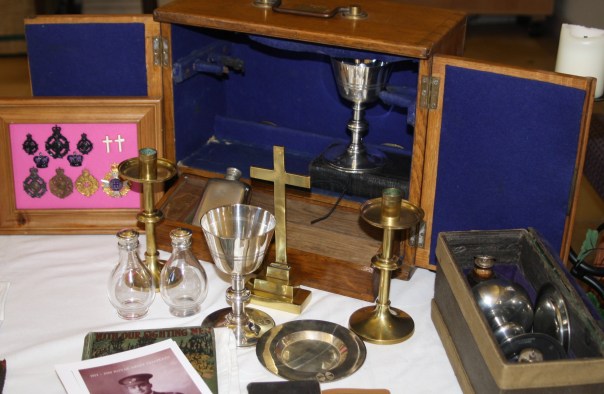
Chaplain Kits of the United Kingdom
Great Britain’s military history (and therefore their chaplaincy history) is much longer than ours in the U.S. See some of the Chaplain Kits used throughout their history at the new United Kingdom Kits page!
.
.

Will God Have a Place?
Shortly after the end of the Korean War, the National Lutheran Council’s Bureau of Service to Military Personnel published a pre-induction training manual titled, “So You’re Going Into Service.” It was designed for Lutheran ministers to prepare candidates for induction into the Armed Forces and covered topics such as nation, God, self, others, leisure time and future, all in relation to the serviceman. In the chapter, “The Serviceman and God” under the subtitle, “Will God Have a Place in My Service Career?” the availability of the chaplain is taught, as well as the chaplain’s need for the service member. Here are a few paragraphs from this section:
“While he is surrounded by many evil suggestions for ways to take up his time and interest, the young man who has prepared himself for this trip and who sincerely wants to come out two or three years hence as a better man than he went in, finds many opportunities for remaining in touch with God.
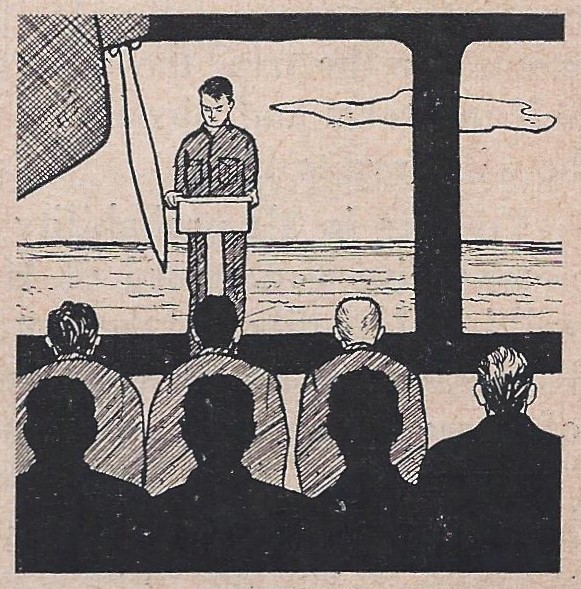 “Wherever you go there will be a Chaplain who wears the crosses on his uniform. (Catholic Chaplains also wear crosses but you will soon learn to know your chaplain.) He will be a clergyman from one of the Protestant churches back home, perhaps of your very own church. He is there because he has seen the need of being with the young men away from home and reminding them of the constant presence of God; he believes that this period of two or three years is not a meaningless interlude where the moral laws of God have been suspended, but is a real part of your life.
“Your Chaplain will be most happy to see you at any time. He will be able to suggest many activities which can occupy you during your off-duty hours. Opportunities for being an active churchman are many in the Armed Services. The Chaplain is to a great extent dependent upon you for his program. You will see to it that the bulletin board has an up-to-date announcement concerning the service schedule. If you can procure some lumber you might build a religious corner in your day-room and keep that supplied with good tracts, devotional booklets, and other religious literature.
“The Chaplain will always need choir members, organists and musicians, ushers and greeters, teachers in the Sunday School, and for some with special musical and typing abilities there will be opportunity to take special training to become a Chaplain’s assistant.
“If God gets a place in your service career, you will have no problem in keeping yourself busy. He will be a constant companion through good and evil days. By your accepting Him as your constant Help and Companion you will not only help yourself, but your very presence will be a reminder of God to your fellow men. You will be for them a symbol of all that is good and beautiful and true which they thought they had left behind them when they said, “Good-bye” to their loved ones.”
.
.
.
From “So You’re Going Into Service.” Washington, D.C.: Bureau of Service to Military Personnel, National Lutheran Council, ca. late 1950’s, pg. 26.
.
.

Orthodox Chaplain Kit
The first Orthodox chaplain kit began being issued by the Army sometime after the mid-1970s. The only one I had seen was at the Chaplain Museum at Ft. Jackson…until this week when an Orthodox chaplain set his kit up for me to shoot! It’s a very beautiful set with a lot of symbolism.
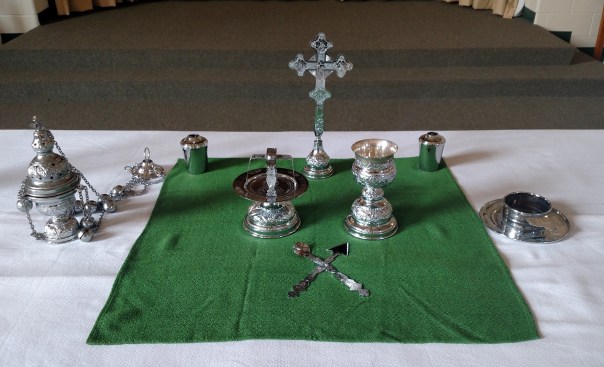
See more pictures of it on our Orthodox Chaplain Kit page!
.
.
.

Chaplain Rabbi Kushner
 I had heard of the book “When Bad Things Happen to Good People” from back in the 1980’s but I didn’t know that the author, Harold Kushner, had been an Army Chaplain. He just served for two years so there isn’t much of his military history to find, but what I could discover (plus a little more) is in his chaplain story: Chaplain Harold S. Kushner.
.
.

1st Chaplain on Beach on D-Day
I first encountered Chaplain Julian Ellenberg in the pages of a 1944 Stars and Stripes I bought. It had a short story buried inside its pages about a unit whose members received several Silver Stars for their part in the Normandy landing on D-Day. Looking a little deeper into his military service as a chaplain, I discovered a man committed to ministry in uniform as he sought to serve those under his care.
Before becoming a chaplain, Ellenberg graduated from Furman University and the Protestant Episcopal Theological Seminary.1 He became the rector of St. Mark’s Church in Chester, South Carolina then St. Peter’s in Great Falls, South Carolina. Upon entering the Army to be a chaplain, Ellenberg attended the Army Chaplain School at Harvard University in Cambridge Massashusetts2 and was promoted from 1LT to Captain sometime before February 1944.3
On 6 June 1944, Chaplain “Julian S. Ellenberg … went ashore on D-Day only 30 minutes after the initial assault troops…
Continue reading this brief military biography of Chaplain Julian Ellenberg…
.
.

Varga Girls Condemned by Chaplain
During World War 2, a few photographers produced pictures of women, sometimes scantily clad, for publication. Sometimes these photographs would appear in “Yank” and other military publications that went to Service Members deployed far from home. “Varga Girls” became famous among men at war, and could often be seen hanging in Soldiers’ work or living areas. Below is an article picked up by Stars and Stripes in 1944, where a chaplain condemned them as being “inspired by the devil”:
Esquire Varga Girl Inspired by the Devil, Army Chaplain Says

One of the “Varga Girls” on a pull-out insert in “Yank” Magazine
“NASHVILLE, Tenn., Aug. 18 [1944] (ANS)- The works of Artists Varga and Petty in Esquire magazine are likened to Japanese surrender tickets and are labeled ‘inspired by the devil’ in an editorial written by a chaplain and appearing in the current edition of the Nashville Army Air Center’s newspaper.
” ‘The devil knows that war causes men to remain for long periods without companionship of their wives and sweethearts so he encourages Varga or Petty surrender tickets in such magazines to corrupt their morals,’ the editorial said.”
I wonder how that chaplain would react to what’s available to Service Members today!
.
.

The article from Stars and Strips, European Theater of Operations, 19 August 1944 (author’s collection).
.
.
The Stars and Stripes, Daily Newspaper of U.S. Armed Forces in the European Theater of Operations, Vol. 4, No. 248, 19 August 1944, page 4.
.
.
.
Commendation for Chaplains
LONDON, 3 April 1944: “No one has been going around pinning medals on chaplains in the U.S. Army for their fighting record, for fighting is not a chaplain’s job. His work, however, often takes him into the combat area, and figures just released by the War Department show that American chaplains have not hesitated to follow their military flocks.
“Casualties among Army chaplains have been exceeded on a comparative basis only by the loss of officers in the Air Forces and in the Infantry. During 1943 19 chaplains were killed in battle, 19 were wounded, one is still missing in action and 33 have died as a result of accidents or illness.
“During the Easter season, when our Christian faith is rededicated, it is fitting that work of Army chaplains should be gratefully acknowledged. It is the chaplain who through personal counsel, discussion of welfare problems, day room talks, service club lectures and at religious services, personalizes “Freedom of Worship” in the lives of us all, and freedom of worship is one of the principles that Democracy protects and for which we fight.”
.
.
.
London: The Stars and Stripes, European Theater of Operations, 3 April 1944, pg 6.
.
.

Training Letter on Prayer
 Chaplain James H. O’Neill was the Chief Chaplain for the Third Army through five campaigns of World War Two with General George Patton commanding. The strong faith, as well as entrenched (and sometimes strange) religious views, of General Patton are well known. These were evidenced in a discussion between Patton and O’Neill about the importance of prayer for the Soldier, after which General Patton requested that Chaplain O’Neill get that message out to his command. As a result, Chaplain O’Neill wrote Training Letter No. 5, dated 14 December 1944, for distribution to the Third Army Chaplains. After reading it, however, General Patton ordered it sent to all of the Third Army commanders, down to Regimental level. Here is the text of Training Letter No. 5:
.
Chaplains of the Third Army,
At this stage of the operations I would call upon the chaplains and the men of the Third United States Army to focus their attention on the importance of prayer.
Our glorious march from the Normandy Beach across France to where we stand, before and beyond the Siegfried Line, with the wreckage of the German Army behind us should convince the most skeptical soldier that God has ridden with our banner. Pestilence and famine have not touched us. We have continued in unity of purpose. We have had no quitters; and our leadership has been masterful. The Third Army has no roster of Retreats. None of Defeats. We have no memory of a lost battle to hand on to our children from this great campaign.
But we are not stopping at the Siegfried Line. Tough days may be ahead of us before we eat our rations in the Chancellery of the Deutsches Reich.
As chaplains it is our business to pray. We preach its importance. We urge its practice. But the time is now to intensify our faith in prayer, not alone with ourselves, but with every believing man, Protestant, Catholic, Jew, or Christian in the ranks of the Third United States Army.
Those who pray do more for the world than those who fight; and if the world goes from bad to worse, it is because there are more battles than prayers. ‘Hands lifted up,’ said Bosuet, ‘smash more battalions than hands that strike.’ Gideon of Bible fame was least in his father’s house. He came from Israel’s smallest tribe. But he was a mighty man of valor. His strength lay not in his military might, but in his recognition of God’s proper claims upon his life. He reduced his Army from thirty-two thousand to three hundred men lest the people of Israel would think that their valor had saved them. We have no intention to reduce our vast striking force. But we must urge, instruct, and indoctrinate every fighting man to pray as well as fight. In Gideon’s day, and in our own, spiritually alert minorities carry the burdens and bring the victories.
Urge all of your men to pray, not alone in church, but everywhere. Pray when driving. Pray when fighting. Pray alone. Pray with others. Pray by night and pray by day. Pray for the cessation of immoderate rains, for good weather for Battle. Pray for the defeat of our wicked enemy whose banner is injustice and whose good is oppression. Pray for victory. Pray for our Army, and Pray for Peace.
We must march together, all out for God. The soldier who ‘cracks up’ does not need sympathy or comfort as much as he needs strength. We are not trying to make the best of these days. It is our job to make the most of them. Now is not the time to follow God from ‘afar off.’ This Army needs the assurance and the faith that God is with us. With prayer, we cannot fail.
Be assured that this message on prayer has the approval, the encouragement, and the enthusiastic support of the Third United States Army Commander.
With every good wish to each of you for a very Happy Christmas, and my personal congratulations for your splendid and courageous work since landing on the beach, I am,
Chaplain James H. O’Neill Third Army Commander
.
.
.
Adapted from “The True Story of the Patton Prayer” by Msgr. James H. O’Neill (from the Review of the News, 6 October 1971), http://www.pattonhq.com/prayer.html, accessed 9 Sep 17.
.
.

A Chaplain’s Preparation
The Technical Manual The Chaplain (TM 16-205), issued by the War Department in 1941, makes clear the necessity of chaplains caring for their own spiritual well-being:
(U.S. Marine Corps photo)
Private devotions. That which is true of the mental side is to a far greater degree true of the spiritual and devotional aspect of a chaplain’s life. It is absolutely necessary for the chaplain to keep in touch with spiritual things. Meditation, prayer, and devotion are more imperatively demanded for the soul of him1 who leads than for those who worship in the pews. Private devotions and religious retreats and study should be systematically observed in all sincerity and honesty and not as a mere routine.2
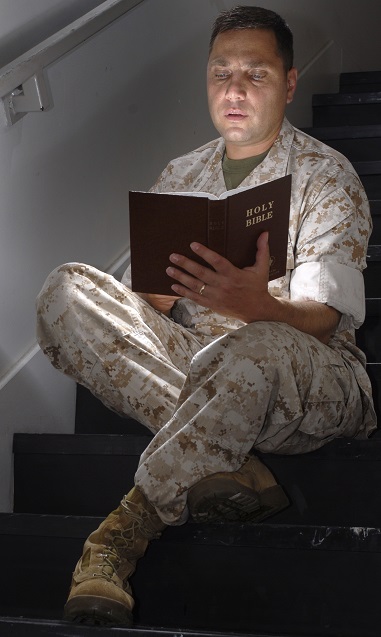
While today most would likely agree that meditation, prayer and devotion are just as demanded for the soul of those who worship in the pews, most would also still agree that the one who leads in worship needs to be well-prepared spiritually to do so.
.
.
.
1 The historical text has been retained, from a time when only men served as chaplains.
2 The Chaplain (TM 16-205). Washington, D.C.: The War Department, 21 April 1941, 21-22.
.
.


 The Chaplain Kit