Category Archives: History

Battle Chaplain (WW2)
This article appeared in Yank magazine, 13 April 1945. Titled, Battle Chaplain, it highlights the ministry of Chaplain Yoder P. Leith of the 338th Infantry Regiment, 85th Division, typical of a chaplain in combat in the European Theater of Operations during World War Two:
He goes up under fire without arms, listens to the TS gripes of his GIs and writes home to their families when they fall.
By Cpl. George Barrett, YANK Staff Correspondent
WITH THE FIFTH ARMY– “I was the traditional clergyman before I came into the Army,” the chaplain said. “Guess I had the idea that being in the clergy I was favored by the Almighty-privileged, in a way. But my first experience under shellfire was with screaming meemies, and when the Jerries opened up with a barrage against my dugout I remember saying ‘Oh, God, wait a minute. Let’s talk this over.’ “
Read the rest of the article here…
.
.
Army Chaplain, His Daughter, A Letter
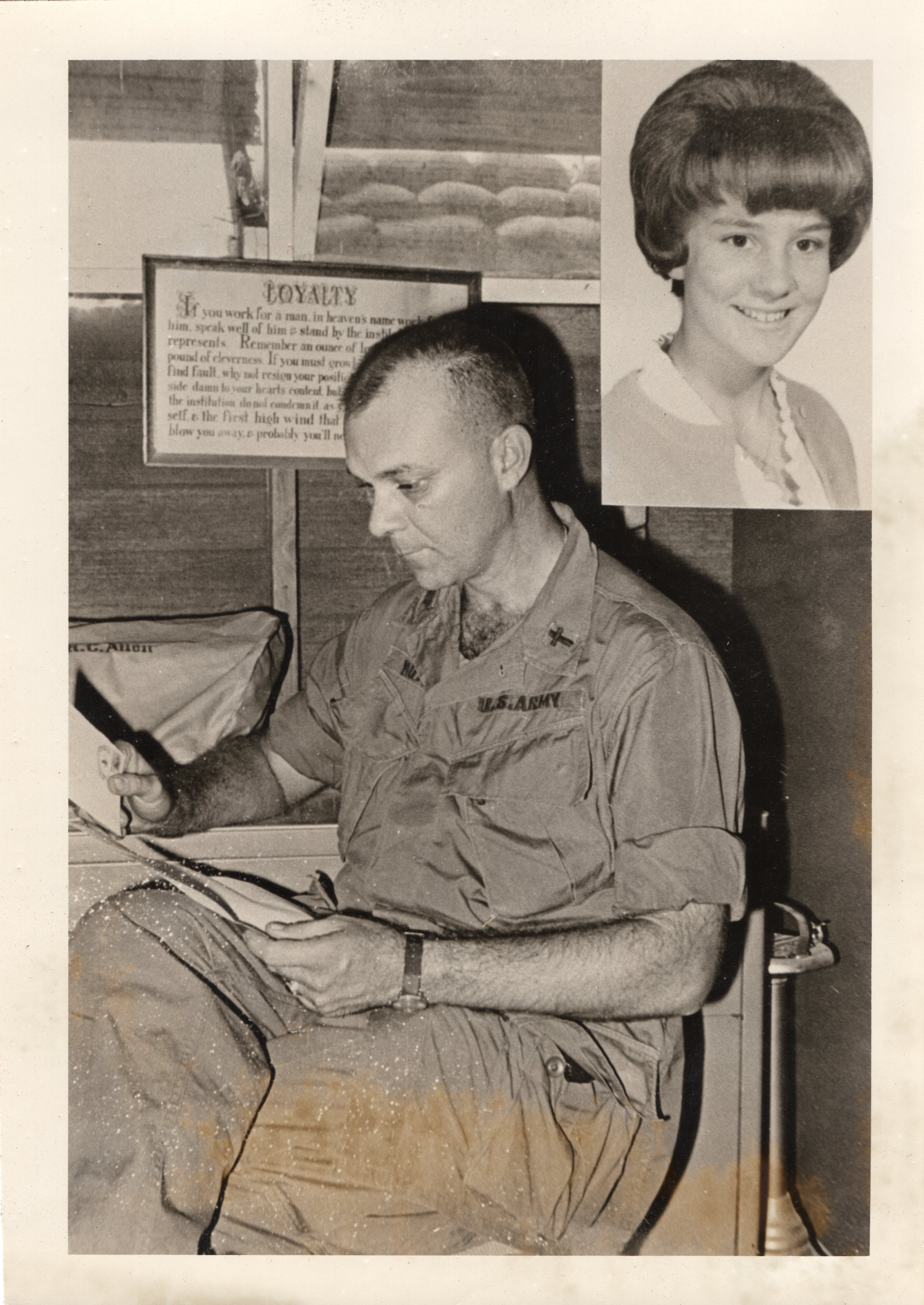
An interesting essay written in 1967 by the 16-year-old daughter of an Army Chaplain deployed to Vietnam. It gives insight into the possible roles available to women in that era. From the 1967 News Release:
QUI NHON, RVN—U. S. Army Chaplain (Lieutenant Colonel) Robert C. Young (wife, Betty L., … Stockton, Calif.), serving with Headquarters and Headquarters Company, 58th Field Depot, received a letter from his 16 year-old daughter, Lynn, a Stagg High School junior in Stockton, Calif., who included a civics class paper that revealed her thoughts on the Vietnam crisis.
Titled “The American Woman’s Role in the Vietnam War,” the article gave Chaplain Young pause for thought.
“I was very surprised that any teenage American student, even my daughter, would be so moved by present world troubles to think at length about them,” reflects the 38 year-old chaplain.
“I am very proud to know some of America’s youth are thinking about their relationship to the world, and wish to put their thoughts into meaningful action,” continues the World War II veteran.
To express her thoughts and bare her emotions, Lynn wrote the following article:
Follow this link to read the article . . .
.
.

In the Foxhole (a Soldier’s Poem)
 Deploying into combat, Soldiers sometimes discover that the dangers of war and the possibility of death cause them to examine their spiritual life and they may choose to re-engage the faith of their childhood or explore religion for the first time. Evidence can be found in nearly every war of Soldiers finding or rediscovering God as a way of coping with the dangers of combat, ensuring their eternal destiny or enjoying abundant life and internal peace in the midst of a world where political peace cannot be found. “A prisoner-of-war came into possession of the following poem written in Normandy by an unknown soldier. The P.O.W. sent it home to England” and it subsequently was published by a Canadian hospital ship named Letitia in 1945:
.
In the Foxhole
Christ, I thought I knew all the answers
Until madness started this war;
I never gave You a second thought,
Nor even talked to You before.
The age-old story of Bethlehem,
And the drama of Calvary,
Were nothing more than mere fairy-tales–
Yes, Lord, mere fairy-tales to me.
 But to-night, my helmet is heavy,
And so is the pack on my back;
Barbed wire has left me two torn hands,
And my feet leave a bloody track.
My shoulders sag ‘neath this heavy gun,
And my body is weary with pain,
And my whole tortured being cries out
For rest and release, but in vain.
For the first time in my life I know
Your head hurt from a thorny crown,
And your tired bleeding Shoulders ached
When that heavy Cross weighed You down.
Those nails cut into Your Hands and Feet,
Every inch of Your Flesh was torn,
And Your bruised Body was weary;
My God, once You too were care-worn!
But You didn’t quit–You carried on
Until the grim battle was through;
And now I know You did it for me–
So I’ll go on fighting for You.
I want You to know I am sorry,
It was my sins put You to death,
And I’ll keep on saying I’m sorry
Until I draw my last breath.
Christ, I never knew war could be the means of saving my soul;
How little I thought that I would find You
In this muddy foxhole.
.


.
.
The Chapel of St. Mark at Fort Marion
 Fort Marion, now a U.S. National Park site, is the oldest existing masonry fortress in the United States. It sits at the harbor entrance at St. Augustine in Florida. The Chapel of St. Mark, which was part of the original fort built by the Spanish, is an excellent representation of Spanish-Catholic commitment to providing a worship space for their garrisoned soldiers.
The Spanish arrived at the present site of Fort Marion in August if 1565 and established the colony of San Agustín in September. Having barely survived attacks from the French and British with their hastily-built forts, on 2 October 1672, the Spanish broke ground on what would become Castillo de San Marcos but it would take 84 years to complete.
In 1740, enough of the fort was completed to offer safety to the besieged garrison and citizens of San Agustín when James Edward Ogelthorpe, from the British colony of Georgia, attempted to conquer it. The fort proved to be impregnable as canon fire from Ogelthorpe’s guns did little damage. During the 27-day siege, “the garrison chapel was the scene of daily Masses, and occasionally marriages and christenings…”1
To continue reading this article click here …
.
.
.
The Jesuit Chapel at Old Fort Niagara
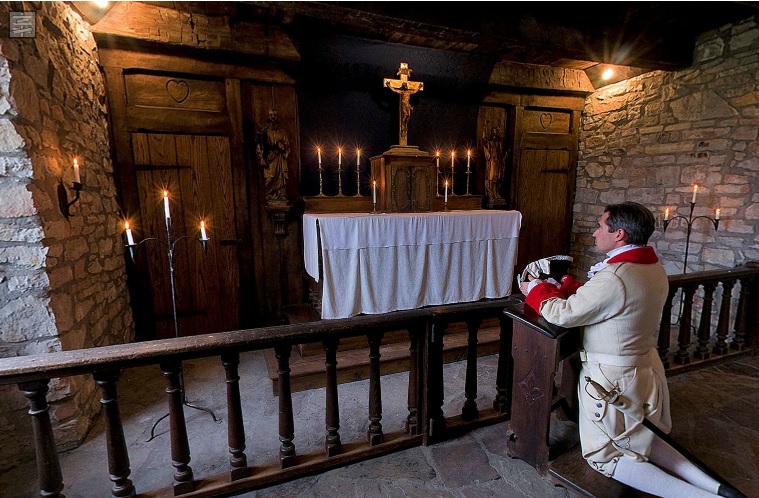
A modern picture of the Jesuit Chapel at Old Fort Niagara showing a French reenactor, from the Old Fort Niagara National Park website.
The French began building on the site of Fort Niagara in 1679. The third building project on the site was the “French Castle” built in 1726-27. As you go up the stairs to the 2nd floor, on the left is the “Jesuit Chapel,” which may be the oldest military chapel in the United States (depending on the criteria used for assessment). The inclusion of a chapel at the fort would have proceeded with little thought, since France was a Catholic country at the time and the majority of its Soldiers would have been devout Catholics, needing an appropriate place to celebrate Mass. When in control of the British, the worship space would have been used for Anglican services, before returning to Catholic use again later in its history.But throughout the life of Old and New Fort Niagara, there has been a chapel available for the worship of God.
To continue reading this article, click here…
.
.
.
.
.
.
Chaplain Corps Prints
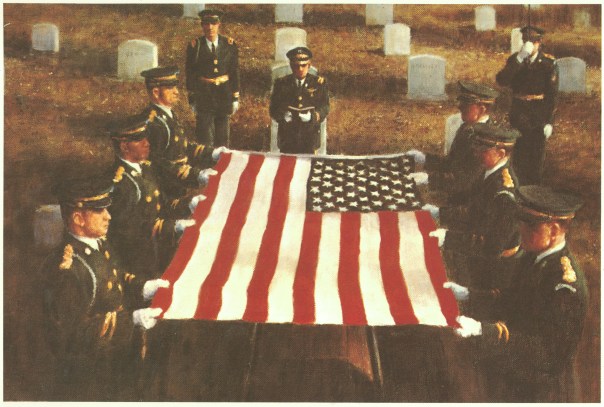
Chaplain Activities: Military Funeral (author’s collection).
Many years ago (during the war in Vietnam) the U.S. Army Chaplain Board produced a series of prints called “History of the Chaplaincy.” Several years later, a second set was produced called, “Chaplain Activities.” “Both [of] these sets were prepared for the purpose of supplying … display materials on the Army Chaplaincy.” Occasionally, you can still find them hanging on the walls of chapels on Army posts, often faded from years in the Sun. If you’re fortunate enough to find sets of them still tucked away in their envelopes, you get a beautiful set of un-faded prints which pictorially show the history and activity of Army Chaplains.
Click here to view the rest of the prints…
.
.
George Washington’s Christian Influence
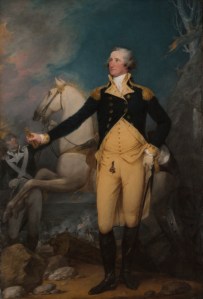
“General George Washington at Trenton by John Trumbull” Yale University Art Gallery
This Christmas season (2015) I came across an interesting article entitled, “Washington’s Christmas Poem…” As it turned out it was less about the Christmas poem that for years people thought Washington, at about the age of 13, wrote and more about the influence that Christianity had on the General of the Continental Army and first Commander and Chief of U.S. forces as well as his subsequent Christian influence on the military and nation.
Many modern scholars deny, or at least down-play, the impact that Judeo-Christian values have had on the United States but if we’re going to be honest with history, we need to acknowledge and accept that influence. Perhaps the fear that modern scholars (or at least those who are pressured by politics) have is that an acknowledgement of the influence of a particular religion in our nation’s history would suggest insensitivity or intolerance to other religions thus denying a foundational principal of our Constitution which both prohibits the establishment of a particular religion by government and protects the free exercise of religion by its people. But I contend that recognizing the role of a particular religion in our history is only that, an acknowledge of our history, and not an establishment of religion or a denial of its free exercise.
With that in mind, I offer the aforementioned article without edit (except for formatting) or additional commentary and with all links intact, for your education and edification. It was written by Ali Meyer and first appeared on cnsnews.com on 24 December 2014, more recently on the same website on 23 December 2015.
Continue reading article by clicking here…
.
.




 The Chaplain Kit