Category Archives: History

A Prayer of Benediction for Chaplain Dale Goetz
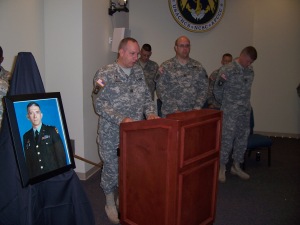
Seven years ago yesterday (30 August 2010), Chaplain Dale Goetz was killed in Afghanistan ministering to his Soldiers. Not wanting to forget his sacrifice, I’m posting this short prayer I prayed at a Memorial Ceremony for him at the U.S. Army Chaplain Center and School.
.
 FT. JACKSON, SC (3 Sep 10) – Recently, the Chaplain Corps lost one of its finest chaplains, Chaplain (CPT) Dale Goetz, in Afghanistan. We received the news here at the Chaplain School while attending the Chaplain Captain’s Career Course. Since many of us knew Dale, and the rest of us felt the camaraderie of a “Brother in Arms,” we felt it appropriate to have a Memorial Service for him. My part was to pray the benediction. As I prepared the prayer, I felt very impressed that Dale needed to be remembered. His sacrifice needed to be remembered. As I post it here, I pray it again . . .
Our most Gracious God and Father,
 We thank you for your presence and love which helps us to endure through difficult times. We thank you for moments like these when we don’t have to be alone but can gather among brothers and sisters in the faith. We thank you for the peace that you have brought us today, your peace—that can exist within us even when all around us there is no peace.
As much as you comfort us who have gathered here today, we pray that in an even greater measure you will comfort Dale’s family, especially his wife Christy and their three sons Landon, Caleb and Joel. Be for them all that they need you to be just now and continue to provide for them in every way in the days, weeks, months and years ahead that they face life without their husband, father and son.
Finally Lord, we pray that you will bring real peace to our land, so that we can rest in safety and comfort and not have to send our sons and daughters into harm’s way. Bring to us, we humbly ask you, the time when parents don’t have to grieve the loss of their children killed in war; hasten the day when spouses don’t have to say goodbye to their loved ones because they serve their country; provide for us, dear Father, a world whose children do not have to grow up fatherless because of the sin that envelopes us; and be victorious, Almighty God, over the Evil One, establish your Kingdom on Earth finally and forever, that we may enjoy your loving and peaceful presence for all eternity.
Go with us now, Lord we pray, as we reluctantly return to the world out there. Please don’t let us soon forget our brother Dale but help us to honor his sacrifice through our lives lived for your glory and Christ’s life lived through us.
“May the God of peace, who through the blood of the eternal covenant brought back from the dead our Lord Jesus, that great Shepherd of the sheep, equip you with everything good for doing his will, and may he work in us what is pleasing to him, through Jesus Christ, to whom be glory forever and ever. Amen.” (Heb 13:20-21)
.
.
.

Religion Follows the Troops
Chaplain Robert P. Canis Describes How Religion Follows the Troops
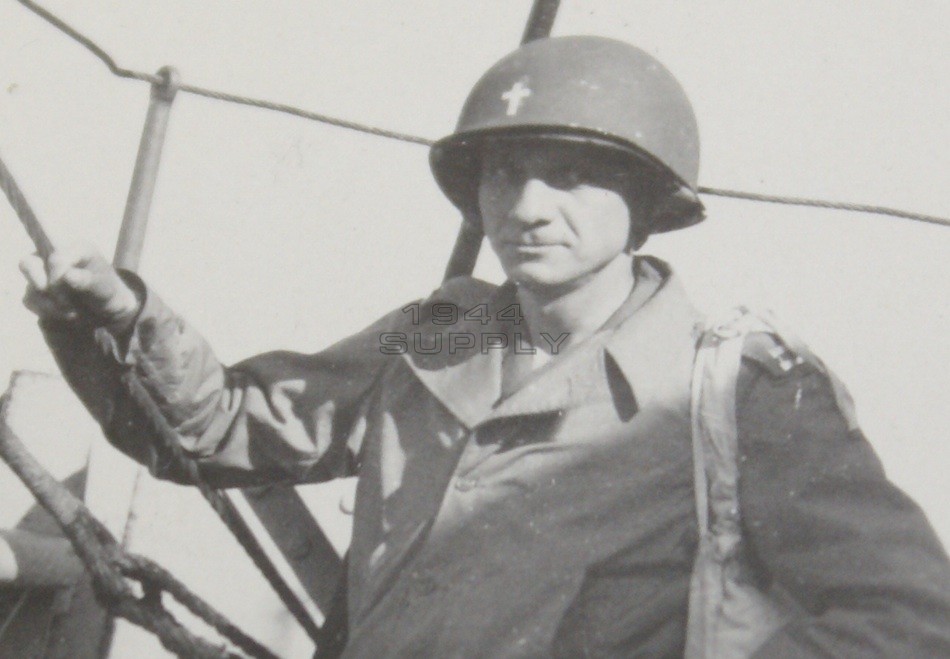 Washington, D.C. [ca. 1945] – Chaplain Robert P. Canis now assigned to a general hospital in Europe has described to the General Commission on Army and Navy Chaplains, Washington, D.C. how he has conducted services in strange and inconvenient places. He pays high tribute to the response given to spiritual matters by American men in uniform. Chaplain Canis said:
“Three weeks after arriving in England, I was assigned to a general hospital. Our chapel was a Nissen hut completely furnished with every aid to worship. In May we took leave of it and ever since have worshiped in a chapel in the fields. In our England staging area that chapel was a long tent with mother earth for pews and a rough board covered with the chaplain’s blanket for an altar.
“On our last Sunday in England this chapel became the scene of a most unusual departure Communion Service. All else was already on its way across the channel. A few hymn books, and a field organ borrowed from a neighboring hospital chaplain constituted the equipment of our tent filled with officers, nurses and enlisted men seeking that extra bit of spiritual strength needed on the shores of Normandy. But in spite of the absence of every traditional touch of a normal chapel service, the atmosphere seemed more alive with honest faith than ever before. Members of all denominations came to the altar to receive the Communion. Some knelt, some stood, and some cupped their hands to receive the bread. Others received it directly in their mouths. While still others served themselves.
Continue reading this article, Religion Follows the Troops…
.
.

Lackland Air Force Base Chaplains’ Program-1950’s
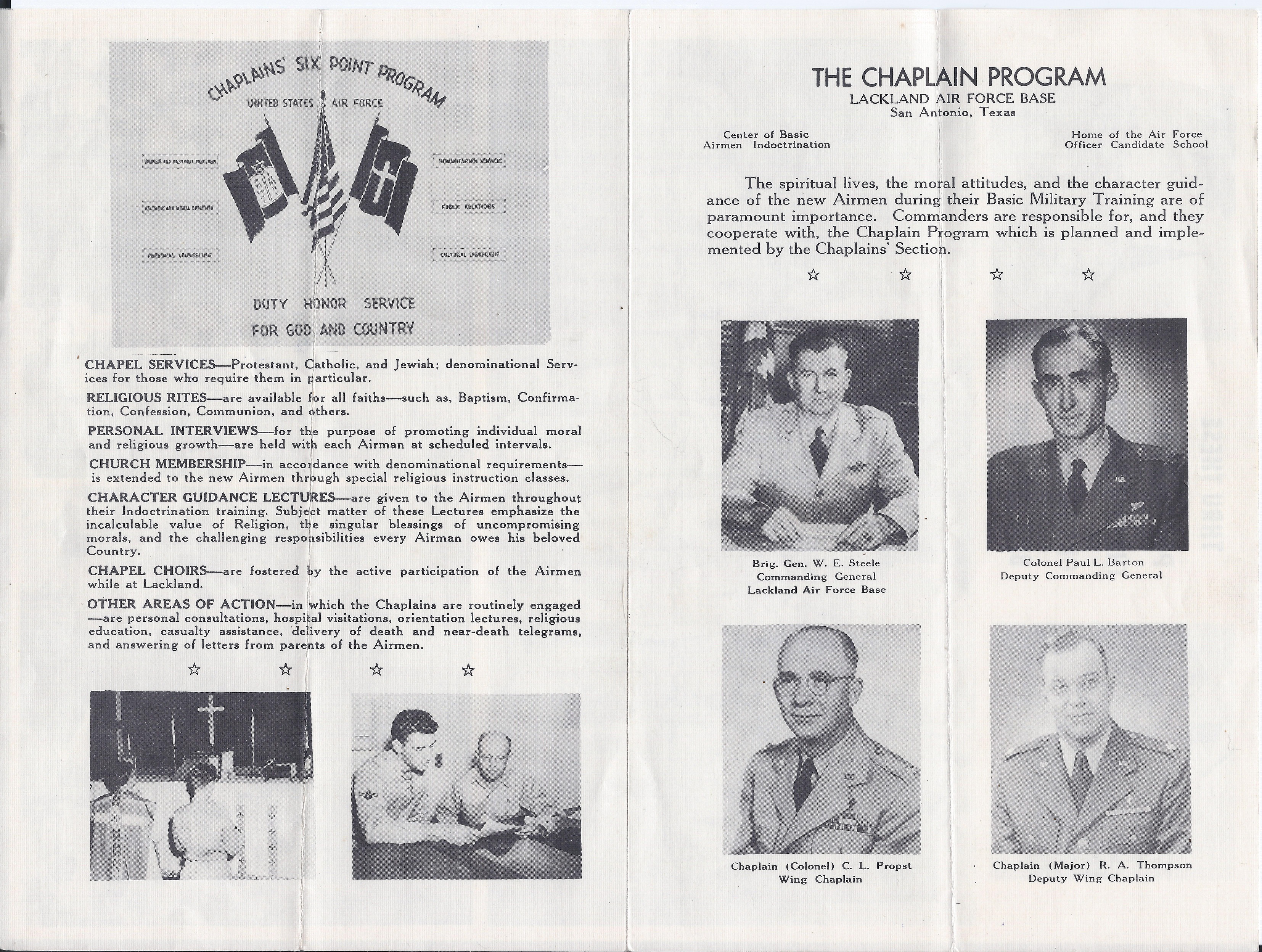
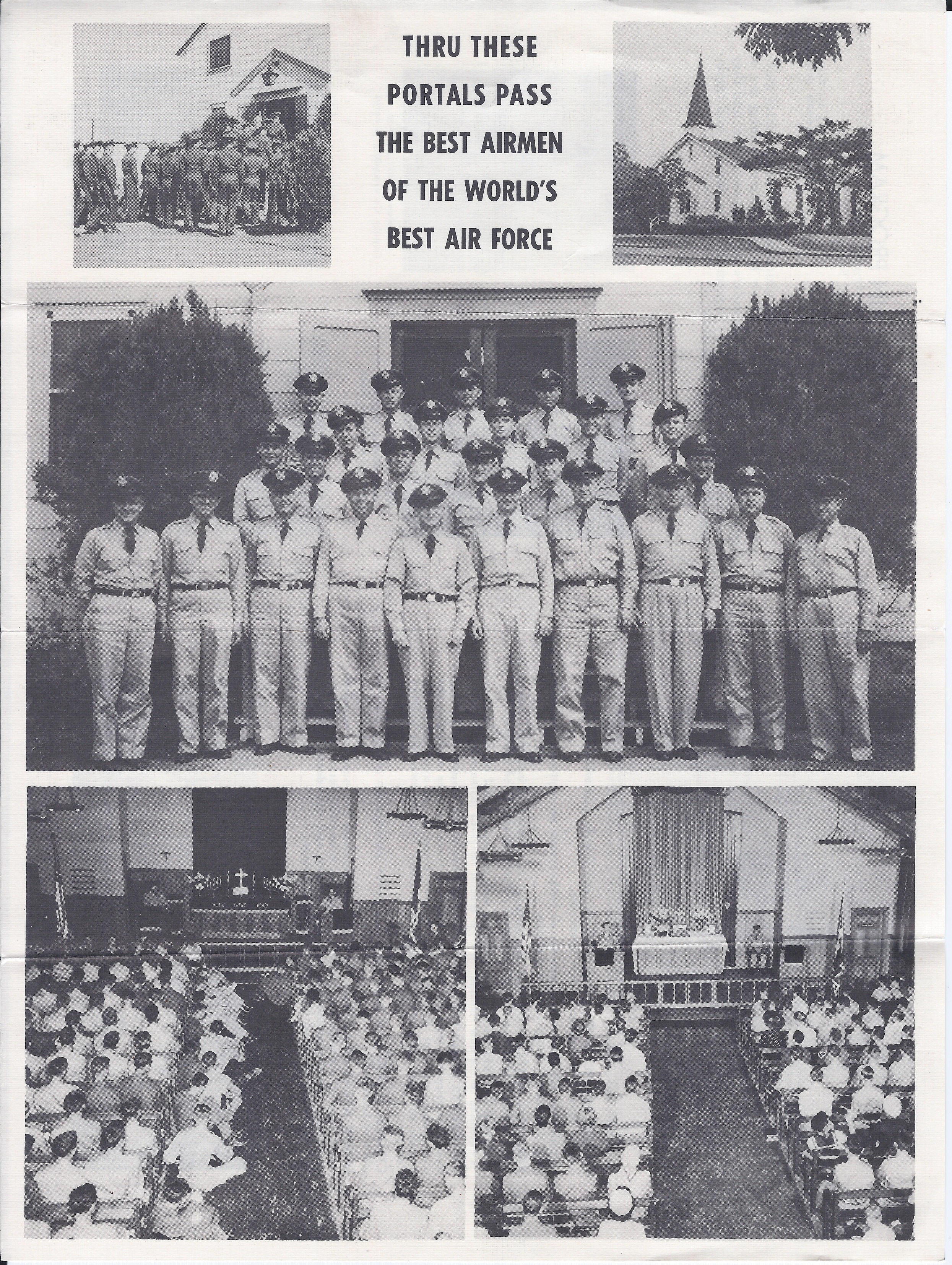
About five years after the establishment of the U.S. Air Force as a separate department of the War Department (Department of Defense by then), the Chaplains’ Department of Lackland Air Force Base, home of the Center of Basic Airmen Indoctrination and the Air Force Officer Candidate School, published a brochure which briefly describes the Chaplain Program of the base. The brochure includes some interesting pictures of religious support operations on Lackland (author’s collection).


.
.
.
.

Army Chaplain Corps Posters
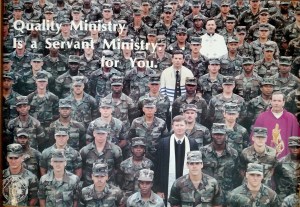 In the 1980s the Army Chaplain Corps produced a number of 24″ x 36″ “motivational” posters that were apparently distributed to unit chaplains to hang in their areas. When I was enlisted in the ’80s, serving at Fort Riley, KS, I remember seeing a couple of these hanging in the HHC Orderly Room of DIVARTY, 1st ID. Here are four that I recently came across (author’s collection).
.
See the rest of the posters by following this link to the “Posters” page.
.
.

In God is our Trust
There’s an old saying, “there are no atheists in foxholes” but any chaplain will tell you there are. Combat has a way of either solidifying one’s faith, pushing one toward faith, or unfortunately, damaging the faith a person deployed with. Nevertheless, chaplains exist to support Soldiers, Sailors, Airmen, Marines and Coast Guardsmen wherever they are (geographically and spiritually) and to provide for their religious expression in combat or at home station.
During World War Two, chaplains were just as active providing worship opportunities for Service Members deployed into harms way. An August 1944 two-page spread in Yank Magazine illustrates this well:
“…In God is our Trust”
“The nearer men get to the front, the less time they have for anything but fighting. All else goes by the board-except an intensified religious feeling, a feeling to which countless letters and dispatches written in foxholes have testified. And so, as is evident in these pictures from the battlefronts of the world, Yanks who can barely manage to spare a few moments to eat or sleep still manage to lay down their arms long enough to worship.”
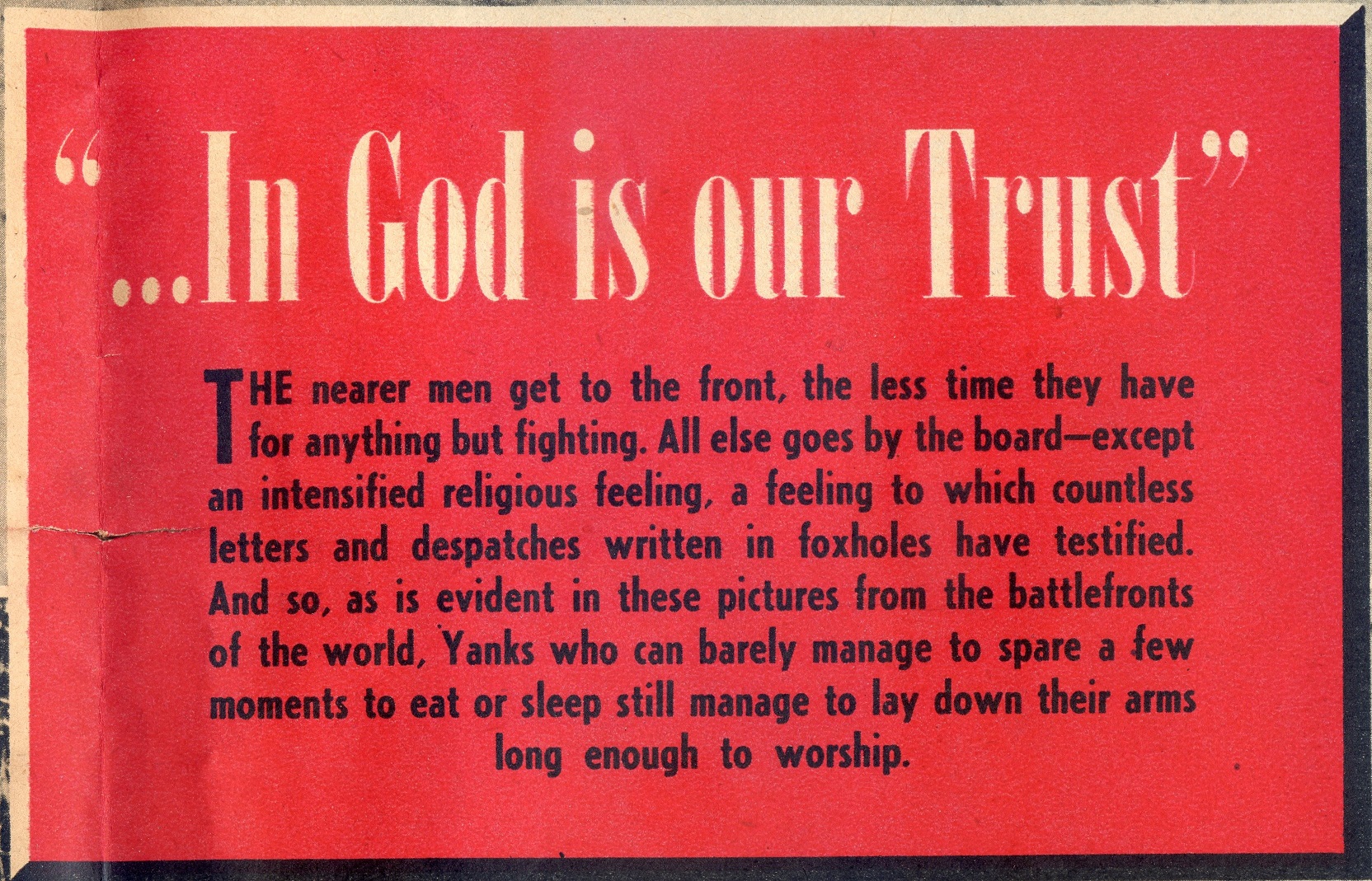
Click here to continue reading this article with nine more pictures of worship on the front lines…
.
.
In Flanders Fields
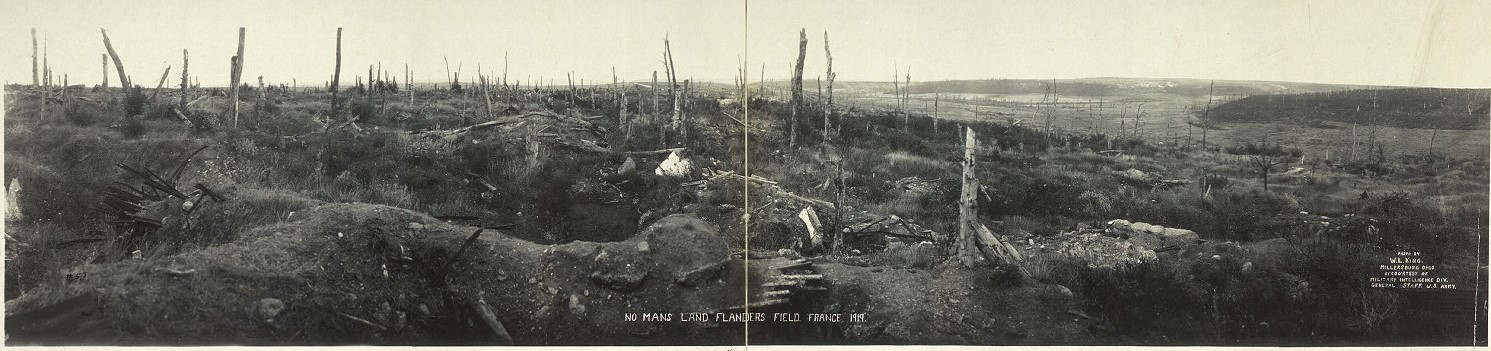
IN FLANDERS FIELDS POEM
The World’s Most Famous WAR MEMORIAL POEM
By Lieutenant Colonel John McCrae
In Flanders fields the poppies blow
Between the crosses, row on row,
That mark our place: and in the sky
The larks still bravely singing fly
Scarce heard amid the guns below.We are the dead: Short days ago,
We lived, felt dawn, saw sunset glow,
Loved and were loved: and now we lie
In Flanders fields!Take up our quarrel with the foe
To you, from failing hands, we throw
The torch: be yours to hold it high
If ye break faith with us who die,
We shall not sleep, though poppies grow
In Flanders fields(Composed at the battlefront on May 3, 1915
during the second battle of Ypres, Belgium)
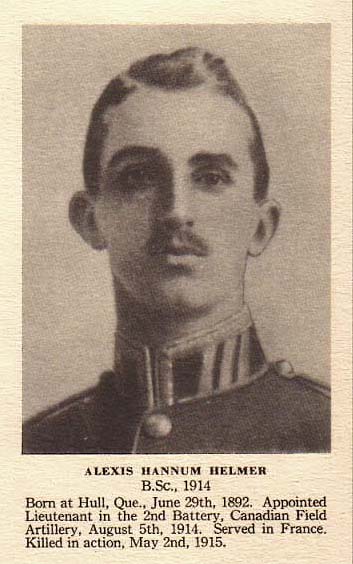 On May 2, 1915, John McCrae’s close friend and former student Alexis Helmer was killed by a German shell. That evening, in the absence of a Chaplain, John McCrae recited from memory a few passages from the Church of England’s “Order of the Burial of the Dead”. For security reasons Helmer’s burial in Essex Farm Cemetery was performed in complete darkness.
The next day, May 3, 1915, Sergeant-Major Cyril Allinson was delivering mail. McCrae was sitting at the back of an ambulance parked near the dressing station beside the YserCanal, just a few hundred yards north of Ypres, Belgium.
As John McCrae was writing his In Flanders Fields poem, Allinson silently watched and later recalled, “His face was very tired but calm as he wrote. He looked around from time to time, his eyes straying to Helmer’s grave.”
.
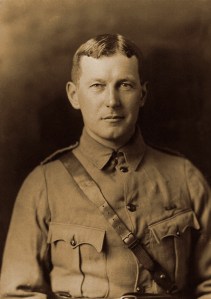
Lieutenant Colonel John McCrae
Within moments, John McCrae had completed the “In Flanders Fields” poem and when he was done, without a word, McCrae took his mail and handed the poem to Allinson.
Allinson was deeply moved:
“The (Flanders Fields) poem was an exact description of the scene in front of us both. He used the word blow in that line because the poppies actually were being blown that morning by a gentle east wind. It never occurred to me at that time that it would ever be published. It seemed to me just an exact description of the scene.”
.
.
.
.
________________________________________
Text used by Permission courtesy of www.flandersfieldsmusic.com
Photo of “No-man’s land” in the public domain
Photo of newspaper picture of Alexi Hannum Helmer, from the “McGill Honour Roll, 1914-1918”. McGill University, Montreal, Quebec, 1926, found at the Canadian Virtual War Memorial, a website of the Veterans Affairs Canada, accessed 29 May 2017
Photo of LTC John McCrae, – Guelph Museums, Reference No. M968.354.1.2x, in the public domain
.
.
Chaplain Hill Captures Three Enemy Pickets
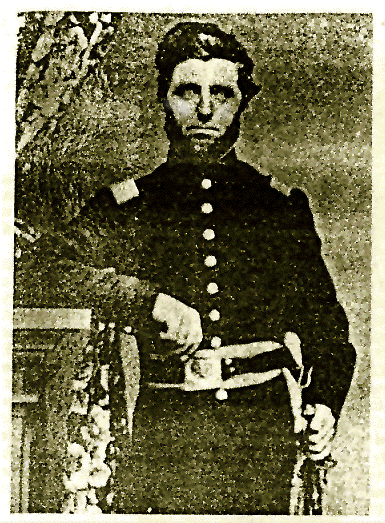 On this day (16 May) in 1863, Chaplain James Hill engaged the enemy and without injury or death captured three enemy pickets, which eventually earned him the Medal of Honor. Here’s the story:
1LT James Hill (21st Iowa Infantry) for capturing enemy pickets at the Battle of Champion Hill in May 1863 (at the time, he was serving as an infantry lieutenant – later he would become his regiment’s chaplain).
“In the waning hours of the battle, Lt. Hill was returning from a foraging mission through dense woods. He came upon three armed Confederate pickets. In his words:
“I realized at once that I had gotten myself into a nasty position. I instantly . . .ordered the… Johnnies to ‘ground arms!’ They obeyed. Then slightly turning my head, I addressed an imaginary guard in the brush with a hasty order to ‘halt… and then gave the order to my prisoners: ‘Single file, march’ and to my imaginary guard: ‘Forward March.’ I hurried toward the command at good speed.”
His quick thinking and ingenuity provided a peaceful solution to a deadly encounter.”
.
.
Source: http://www.iowahistory.org/shsi/museum/exhibits/medal-of-honor/hill_james_cw/index.htm (cited on the U.S. Army Chaplain Corps Facebook page).
.
.
.


Easter in Uniform
Wherever Soldiers, Sailors, Airman and Marines go, Chaplains go with them to provide for worship and other religious events. Easter is no different, and for Christians, even brings a greater emphasis when deployed and away from home. Below are a few pictures and worship bulletins from Easter celebrations from years past.
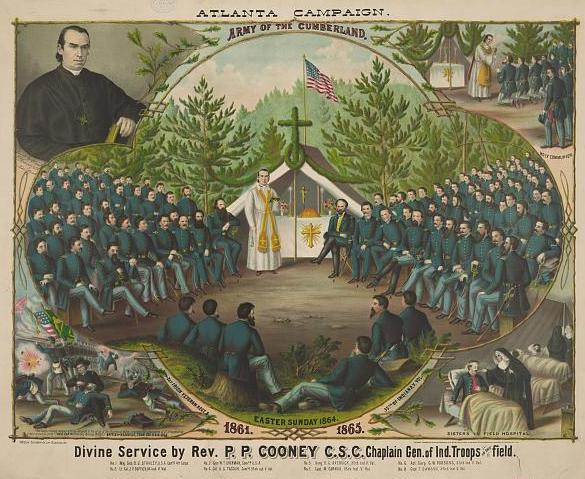
Catholic Chaplain celebrating Mass on Easter in 1864. Photo credit: http://the-american-catholic.com/tag/catholic-chaplains/
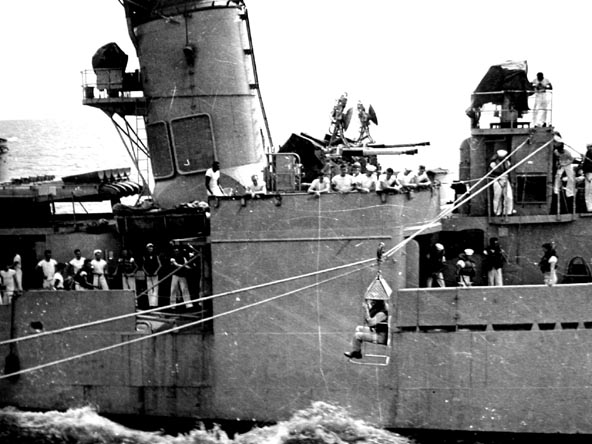
Transferring the chaplain for Easter service by highline from the U.S.S. HEERMANN DD-532
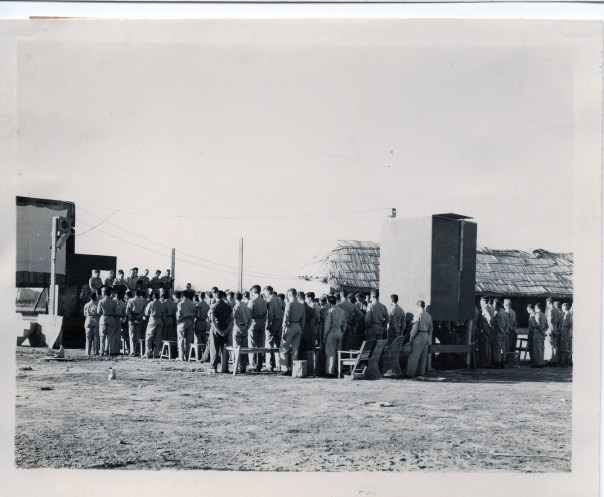
Outdoor Easter service for Army Air Corps Soldiers, 9 April 1944.
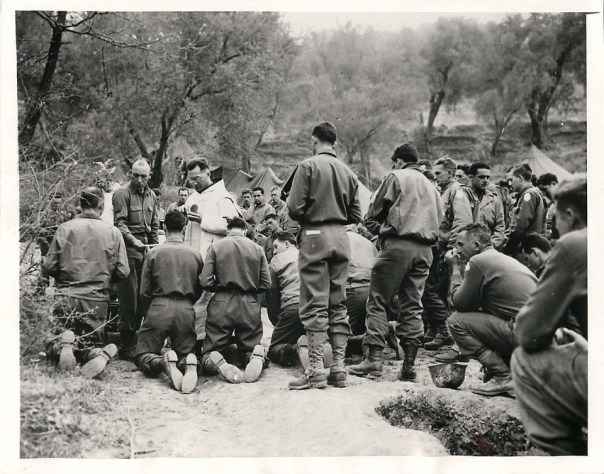
“EASTER COMMUNION-‘SOMEWHERE IN ITALY’: Chaplain Capt. William A. Faber, of Chicago, Ill., gives troops of the Allied Fifth Army Holy Communion in a special Easter Day service in a Vivouac area somewhere in Italy. 4/18/44.”
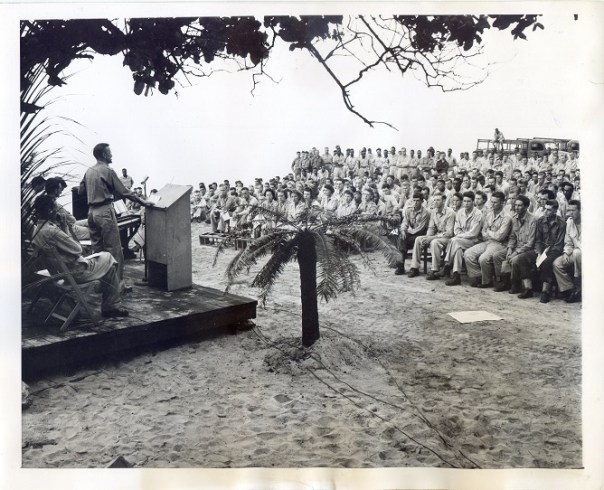
“EASTER SERVICES CLOSE BY CORAL SEA NEW GUINEA—A beach fronting the Coral Sea serves as a church for this Easter Sunrise Service somewhere in New guinea. Capt. A. B. Po*sgrove, U.S. Army Chaplain, is shown delivering his sermon to part of the crowd of 600 men and women who attended…4/19/44” (TCK Archives).
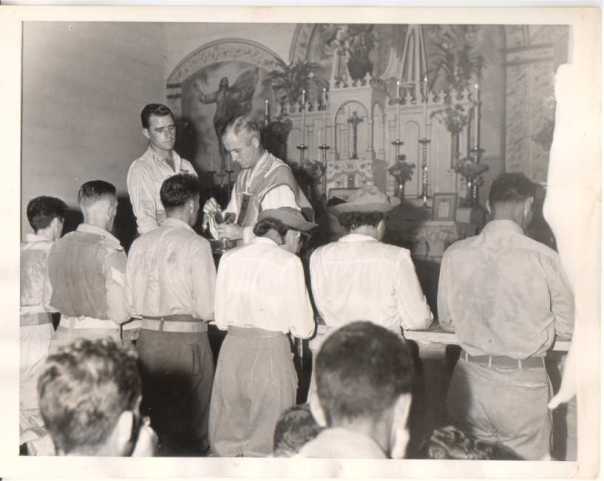
Easter Mass being offered to Service Members, 19 April 1944.
“EASTER IN THE FIFTH ARMY…ITALY–Incongruous as it seems, on Easter Sunday all fighting on the Fifth Army front ceased while both German and American forces joined in paying tribute to the Prince of Peace. Capt. Oscar Reinboth, Seward, Nebr., Lutheran Chaplain for the American Forces, Broadcasts in German the details of the program to follow. H also read the Easter story in both English and German. Behind Capt. Reinboth is the altar, which was brought up the mountainside by mule pack. At the conclusion of the hour-long services, fighting was resumed. Not a shot, however, was fired during the ceremony. 4/20/44.”

“One of many Easter services held on Appenine mountainsides by the Tenth Mountain Division April 1, 1945; conducted by Caplain William H. Bell for the 605th Artillery Battalion at Rocca Pitigliano. A large group of soldiers sit in a grassy open field with heads bowed. Before them stands the chaplain with a box beside him, a jeep marked beneath the windshield with ‘Chaplain’ in between two crosses, and a portable pump organ.”
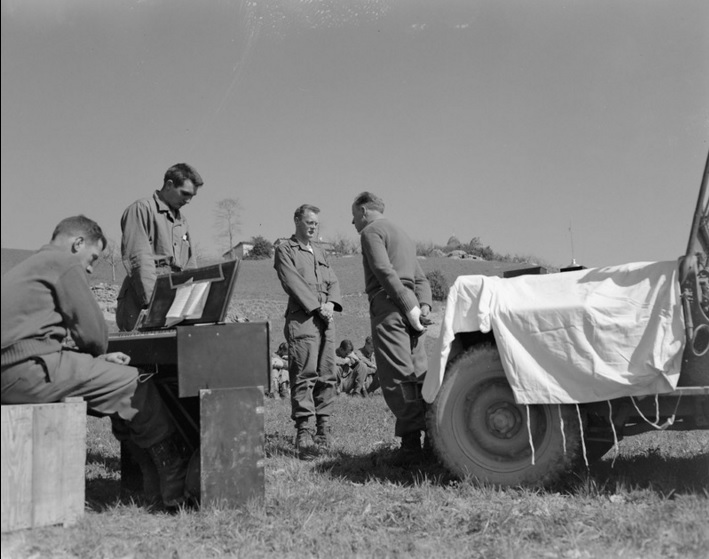
“April 1, 1945. Protestant Easter Service in Appennines, Italy
background are trees and buildings.; Members of the Tenth Mountain Division, 605th Artillery Battalion, attend a Protestant Easter religious service at Rocca Pitigliano, Italy, conducted by Chaplain William H. Bell. In the foreground, four men bow their heads together. Corporal Ralph Squires sits at a portable organ and two soldiers face the Chaplain who stands in front of his jeep draped with a white cloth in use as an altar for a small crucifix.”
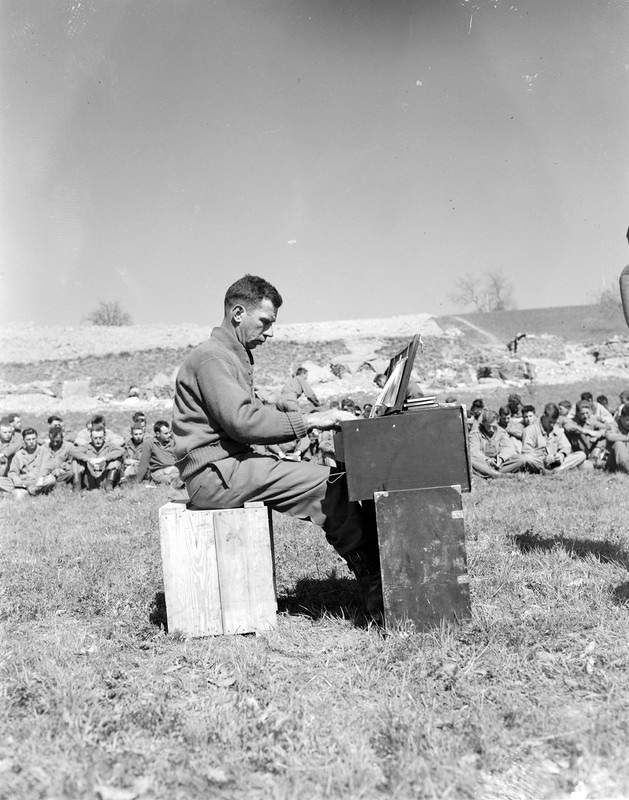
“Tenth Mountain Division Cpl. Ralph Squires plays the organ during the 605th Artillery Battalion Protestant Easter service held April 1, 1945, at Rocca Pitigliana, Italy. Worshipers sit on grass listening.”

Easter services 339th Fighter Group April 1945
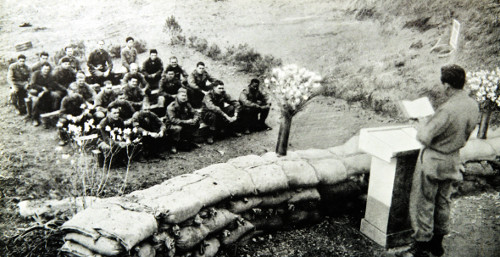
In 1952, soldiers of the 15th Infantry Regiment of the 3rd Division participate in Easter worship service in the open field in Cheolwon, Gangwon-do.
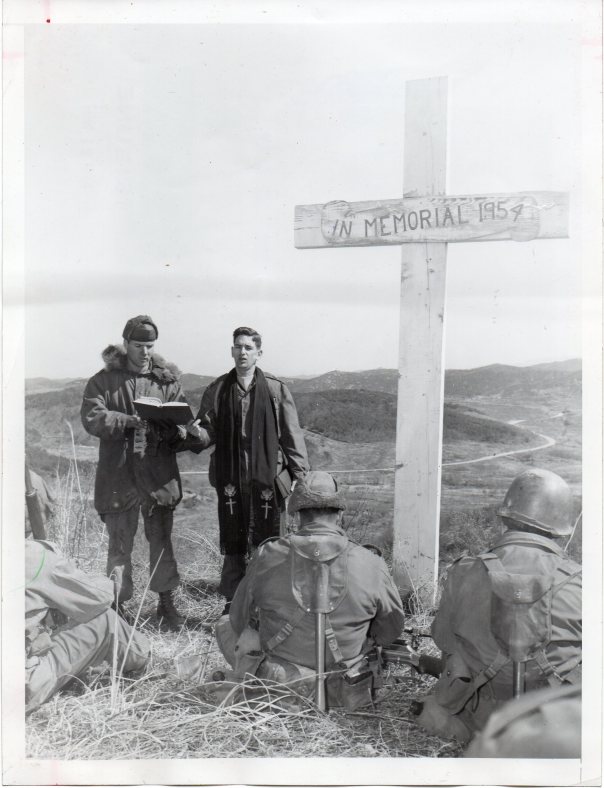
“EASTER SERVICES IN KOREA…A scene that will be re-enacted at sunrise, Easter morning, is pictured here as troops conduct religious services before a cross just south of the neutral zone between North and South Korea. Chaplain 1st. T. Elbert L. Nelson, Worthington, Ohio, leads service, aided by SP/3 Earl D. Groff, Soap Lake, Wash. (holding hymnal). 3/19/57 (TCK Archives).

Worship service for Navy personnel. Looks like Easter (TCK Archives).
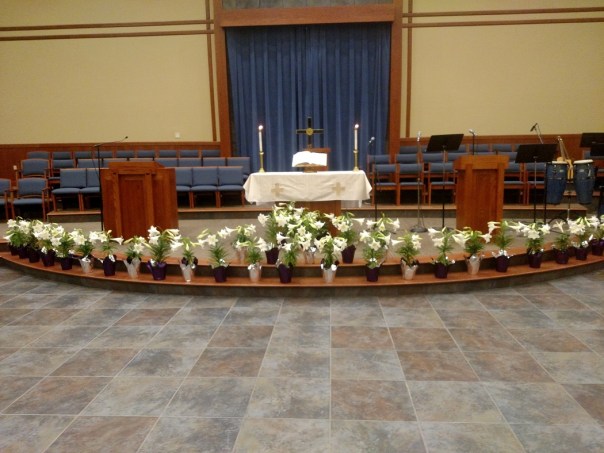
The sanctuary prepared for the Easter Sunrise Service at Main Post Chapel, Fort Leonard Wood, MO, 16 April 2017 (TCK Archives).
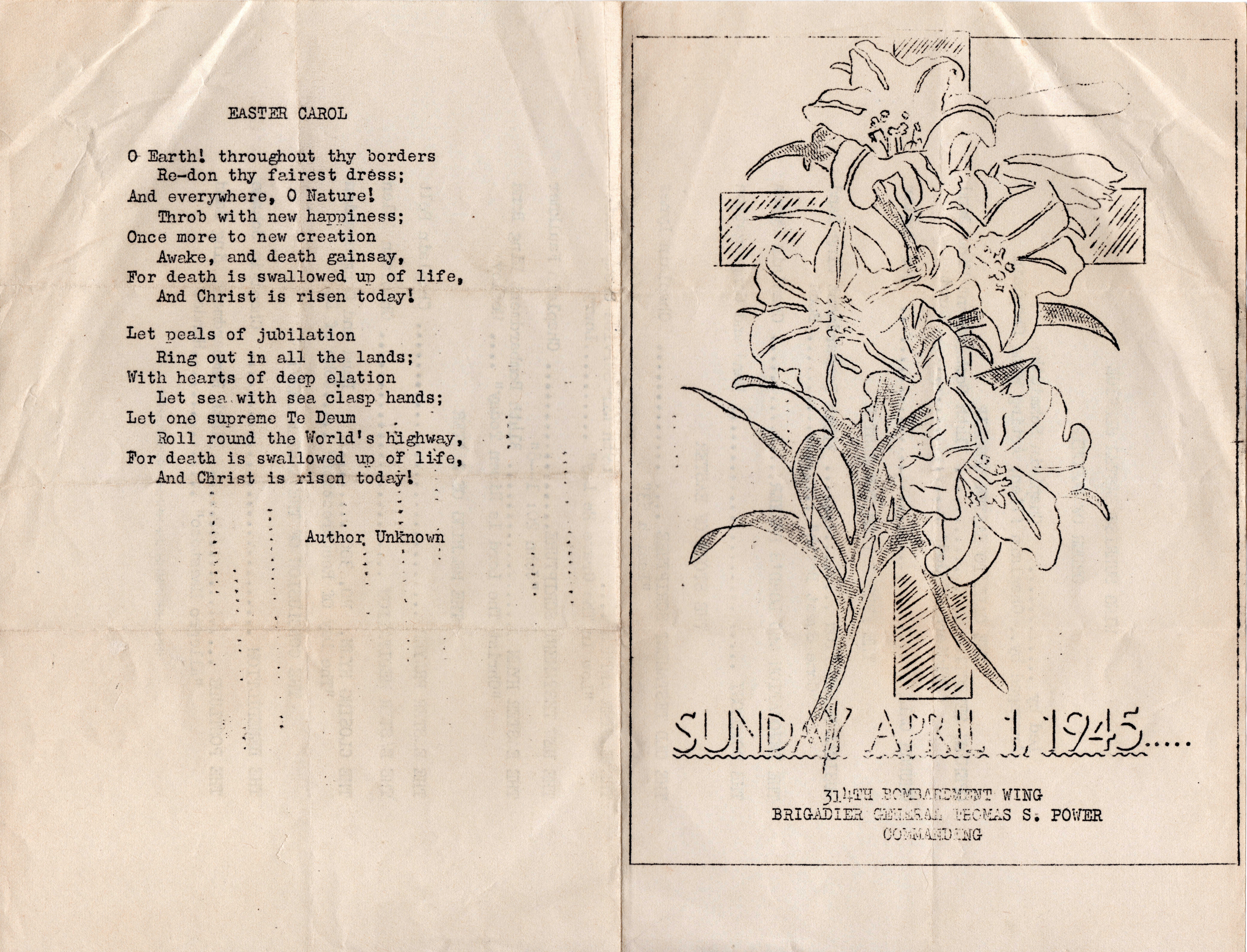
Easter Worship Service bulletin, 1 April 1945, 314th Bombardment Wing, Guam (TCK Archives).
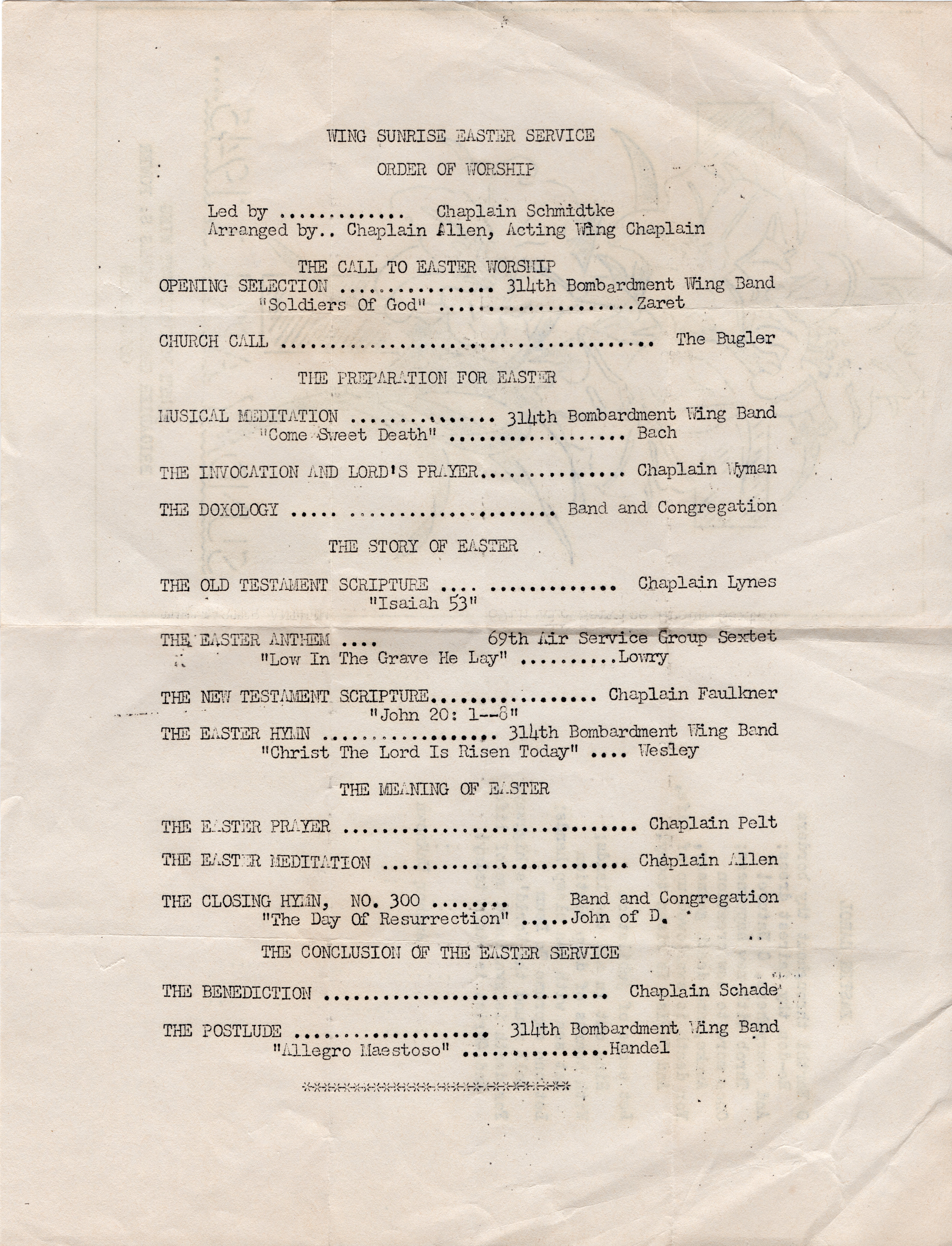
Inside of Easter Worship Service bulletin, 1 April 1945, 314th Bombardment Wing, Guam (TCK Archives).

Allied Protestant Sunrise Easter Service, In front of the 17th General Hospital, Italy, 1 April 1945 (TCK Archives).
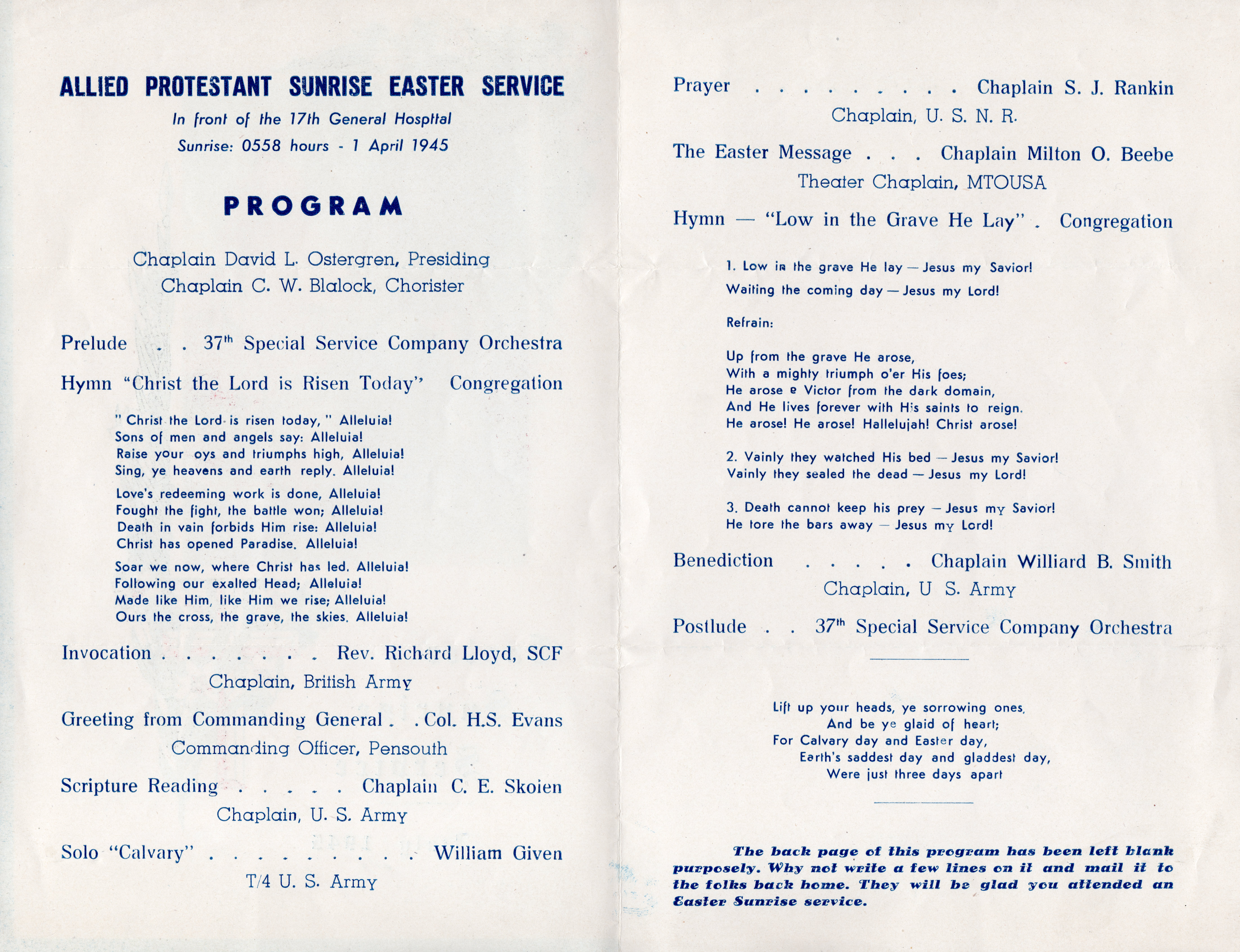
Allied Protestant Sunrise Easter Service, In front of the 17th General Hospital, Italy, 1 April 1945 (TCK Archives).


Worship bulletin from the Easter Sunrise Service in Tokyo, Japan, 10 April 1955 (TCK Archives).
.
.
.

Fort Jackson’s Cantonment Chapel
Similar to U.S. military posts around the country during the train-up to our participation in WW2, Fort Jackson had built on it 17 cantonment chapels to accommodate the religious support of the thousands of new Soldiers who were flooding into it for training. Today, there are few of these chapels left, some posts having one or two being used, others with one being preserved as part of the museum system or historic districts. Fort Jackson has one of these chapels remaining which, due to budget cuts, is slated to be razed. On 13 December 2016, The State newspaper did an article on the future of their Memorial Chapel.
Should Fort Jackson’s World War II-era Memorial Chapel be saved from demolition?
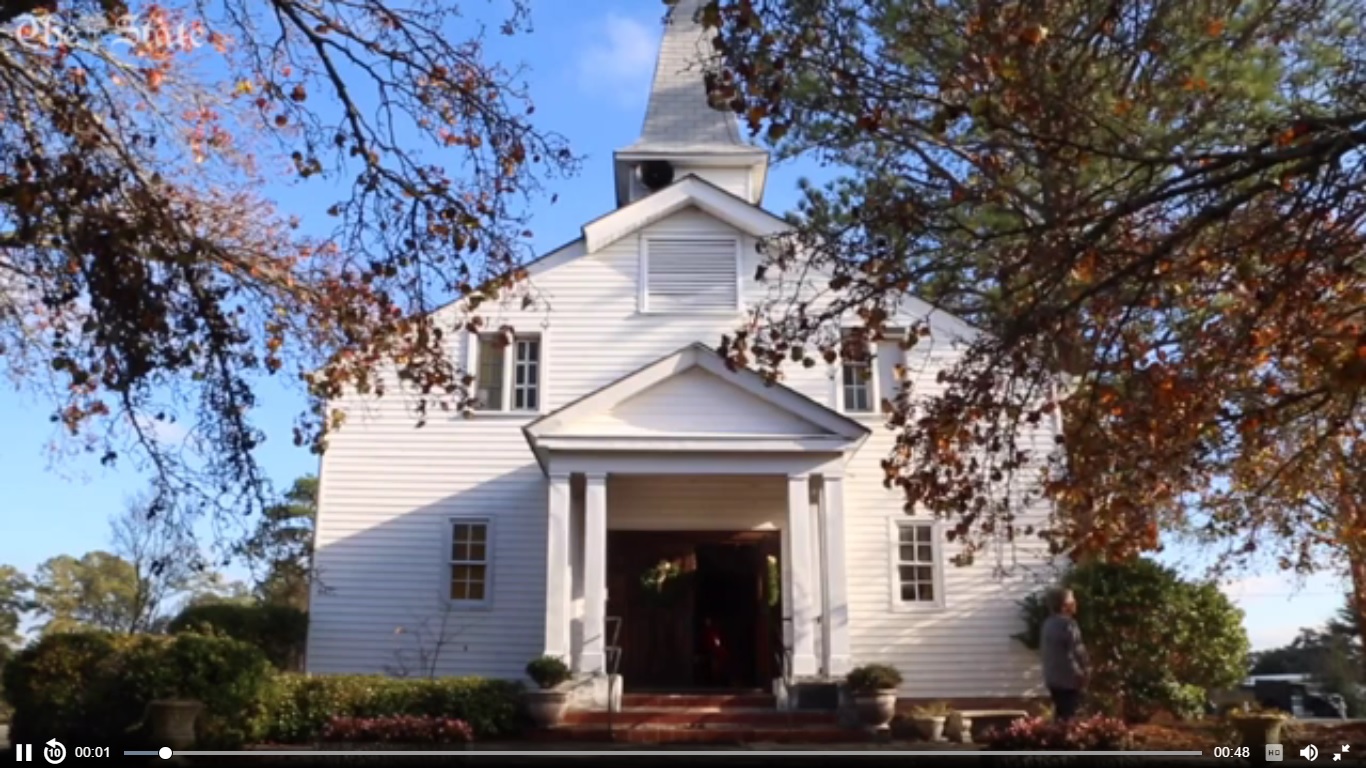
Memorial Chapel (Originally Chapel #1) was built in 1941 (Photo from The State website).
“For more than 30 years, Kathryn Woodward has attended an interdenominational worship service each week at the World War II-era Memorial Chapel on Fort Jackson.
“Today, the chapel, along with all other World War II-era wooden buildings on Army installations across the country, is slated for demolition. They are inefficient, expensive to heat, cool and maintain, and they don’t fit the needs of the modern workplace, the Army says.
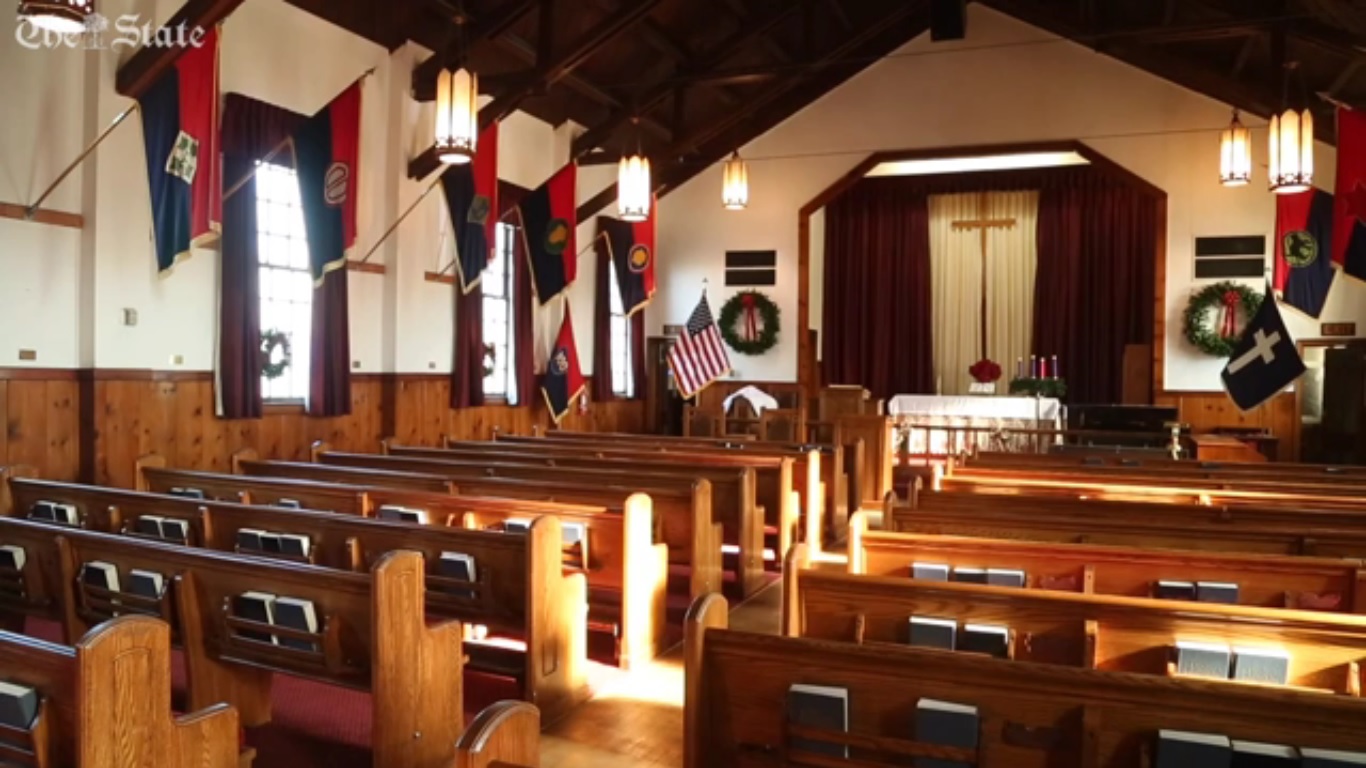
Interior of Memorial Chapel (photo from The State website).
“But Woodward, 92, believes the chapel should stay because in 1983 it was dedicated by then-Fort Jackson commander Maj. Gen. Albert Akers to all the soldiers who trained at Fort Jackson for service in World War II. Woodward’s late husband, Arthur, was also a World War II veteran.
“ ‘We’re trying to get an exception,’ said Woodward, who is joined in the effort by many of her fellow 40 or so congregants, along with a Jewish congregation that also worships there.”
Continue reading at The State website …




 The Chaplain Kit