Category Archives: Chaplaincy

The Chaplain is the Friend of Every Soldier
In 1941, as the United States was gearing up for its inevitable entry into World War 2, the Army published a booklet to prepare men (at that time) to enter the military service, titled “The Army and You.” It included topics like military courtesy, health, equipment, chow (“Good Food–and Plenty of it”!), promotions and pay; as well as what to expect at the Induction Station, Reception Center and Replacement Training Center.
Of course, one of the benefits of military service this 14-page booklet discusses is the chaplain, as did many promotional pieces of the day. Here’s the paragraph dedicated to soldiers’ religious life and the chaplain who is there for them:
The Chaplain is the Friend of Every Soldier
There are opportunities for religious worship at all posts, camps, and stations. Although attendance is not compulsory, every inducement is offered the soldier to attend church services, either at the post chapel or at the church of his faith in the nearby towns. Become acquainted with the chaplain. Part of his duty is to serve as your friend, counsellor, and guide, no matter whether you belong to his church, another church, or to no church.
.
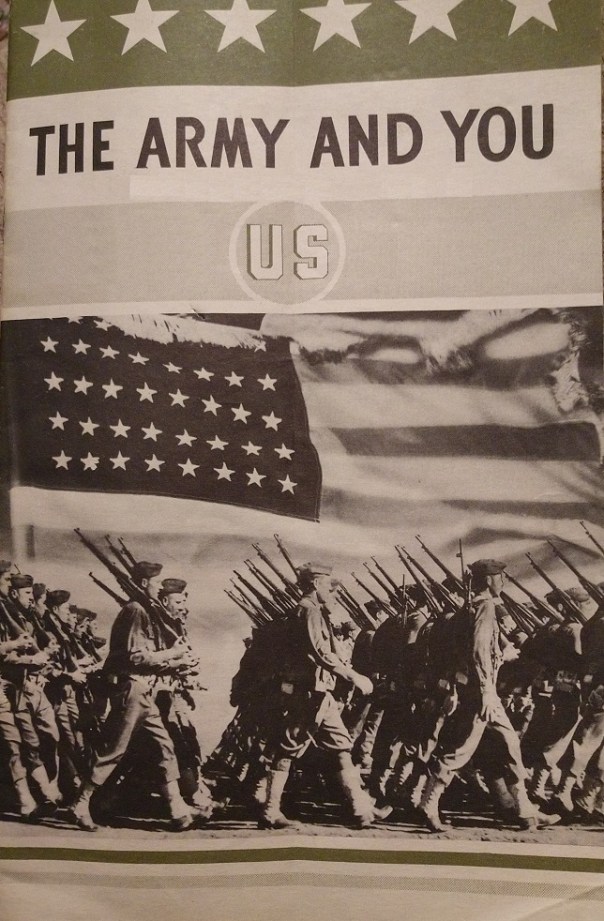
The cover invites the potential soldier into the camaraderie found, among other places, a formation of men marching with weapons. “The Army and You,” U.S. Government Printing Office, 1941 (author’s collection).
.
.

A Chaplain’s Reflection on 9/11
September 11, 2001 began like any other day for me. I wasn’t a chaplain yet, but was a pastor at a civilian church in Upstate New York. It was a Tuesday, so I was meeting with men from the church for breakfast at the Corner Cafe just a few miles down State Highway 96 from my church in Clifton Springs, New York.
The breakfast for us was uneventful. As I recall, there were just a few who showed up this particular week, but we enjoyed a great breakfast and good conversation as we always did. Eventually it was down to just Cliff and I finishing our coffee before we left, when another patron mentioned that a plane had run into the World Trade Center. I found that a bit hard to believe and Cliff and I exchanged looks of disbelief. I finished my coffee and headed home, only mildly curious what may have happened that caused that other customer to think a plane had hit such a large building in broad daylight.
When I got home, I knew it was more than a misunderstood news story. I saw it in my wife’s eyes.

A friend of my wife had called and told her to turn on the TV so it was already on as I took my place with millions of other people around the world to watch what was going on in New York City, just 300 miles away from me. It wasn’t long before I saw the 2nd plane hit the 2nd tower and the news anchors begin to speculate that perhaps this wasn’t some sort of freak accident.
Over the next several minutes, or maybe it was hours, I watched many other images that have become iconic in our country’s collective memory: flames and smoke bellowing out of the twin towers; men and women jumping to certain death to escape what must have been unbearable heat; rescue workers rushing to the scene, many of whom would not survive that day; first one, then the other tower of the World Trade Center cascading down to a mound of rubble.
Then came news of the plane that hit the Pentagon and later the downed plane in Shanksville, Pennsylvania. Our country seemed so vulnerable. We were under attack and it appeared as though it couldn’t be stopped.
About then my “pastor sense” kicked in and I knew that I needed to do something, anything. If I was torn up inside watching what was going on, I knew that many in my community would be too. I immediately went over to the church, unlocked the doors and turned on the lights. I started soft music playing in the sanctuary and put a message on the church marquee which simply said, “Open for Prayer.” As it turned out, churches across the country had been doing the same thing. In a time when people felt alone, vulnerable and helpless, being able to pray gave them a way to do something to help. It gave us something to do.

My kids had a 4-H meeting that night, but with all that was going on, my wife needed to keep them close. She couldn’t let them out of her sight. When I think back on it, it reminds me of the passage, “He will cover you with his feathers, and under his wings you will find refuge; his faithfulness will be your shield and rampart” (Psalm 91:4). I think my wife wanted to keep the children close for her peace of mind, but also not knowing how widespread this situation may be and where the next attack may take place, she was doing what she could to protect them.
I knew that in just a few days it would be Sunday and I would be facing my congregation so needed a word from the Lord. My mind went to Luke 13:1-9:
Now there were some present at that time who told Jesus about the Galileans whose blood Pilate had mixed with their sacrifices. Jesus answered, “Do you think that these Galileans were worse sinners than all the other Galileans because they suffered this way? I tell you, no! But unless you repent, you too will all perish. Or those eighteen who died when the tower in Siloam fell on them—do you think they were more guilty than all the others living in Jerusalem? I tell you, no! But unless you repent, you too will all perish.”
Then he told this parable: “A man had a fig tree growing in his vineyard, and he went to look for fruit on it but did not find any. So he said to the man who took care of the vineyard, ‘For three years now I’ve been coming to look for fruit on this fig tree and haven’t found any. Cut it down! Why should it use up the soil?’
‘Sir,’ the man replied, ‘leave it alone for one more year, and I’ll dig around it and fertilize it. If it bears fruit next year, fine! If not, then cut it down.’”
I did not claim that the attack was a result of the sins of the United States. Neither did I claim that those who died, died because they needed to repent. Instead, I expressed what seemed to be the thrust of the passage, that those who die by tragedy are no worse sinners than we are, but if we need to repent and don’t, judgment may truly befall us-both physical and spiritual-both individually and corporately. As I recall, it was well received as the tragedy of 9/11 caused many Americans to really reflect on what was important in life and if our relationship to God was all it could be.
I had already been talking to a chaplain recruiter for over a year about going back into the Army as a chaplain, and had been attending Northeastern Seminary since the Fall of 2000 working toward meeting the Army chaplaincy’s educational requirement. This new attack on my country, however, caused me to redouble my efforts with a greater urgency. I knew that the world we lived in would be changed forever, especially for our military members, so I wanted to do my part. Many in the United States had the same desire as enlistments spiked a bit after 9/11 not leveling out until 2005.

Me (on left) with one of my Chaplain Assistants in Basrah, Iraq, about to go visit our troops.
The attacks of 9/11 did cause me to review my reasons for joining the Army, however. Before 9/11, it was essentially a garrison Army training for war. Now, there was little doubt that anybody who joined would deploy to a combat zone in some far away land (for me and many others, it was both Afghanistan and Iraq). But I recognized that this is the time when service members would most need spiritual guidance, encouragement and support. As a non-combatant by virtue of my position as a minister, this is what I could offer them. I could go with them, even into harm’s way, and “bring God to Soldiers and Soldiers to God.” Finally receiving my commission and reporting for duty in January 2004, this has been my life ever since.
.
.

A Prayer of Benediction for Chaplain Dale Goetz
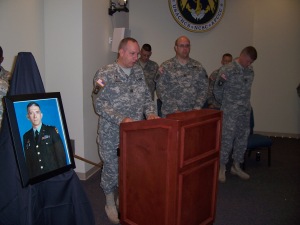
Eight years ago (30 August 2010), Chaplain Dale Goetz was killed in Afghanistan ministering to his Soldiers, the first chaplain to die in combat since the Vietnam War. Wanting his sacrifice to not be forgotten, I’m reposting this short prayer from a Memorial Ceremony for him at the U.S. Army Chaplain Center and School held a few days after he died.
.
 FT. JACKSON, SC (3 Sep 10) – Recently, the Chaplain Corps lost one of its finest chaplains, Chaplain (CPT) Dale Goetz, in Afghanistan. We received the news here at the Chaplain School while attending the Chaplain Captain’s Career Course. Since many of us knew Dale, and the rest of us felt the camaraderie of a “Brother in Arms,” we felt it appropriate to have a Memorial Service for him. My part was to pray the benediction. As I prepared the prayer, I felt very impressed that Dale needed to be remembered. His sacrifice needed to be remembered. As I post it here, I pray it again . . . -Daryl
Our most Gracious God and Father,
 We thank you for your presence and love which helps us to endure through difficult times. We thank you for moments like these when we don’t have to be alone but can gather among brothers and sisters in the faith. We thank you for the peace that you have brought us today, your peace—that can exist within us even when all around us there is no peace.
As much as you comfort us who have gathered here today, we pray that in an even greater measure you will comfort Dale’s family, especially his wife Christy and their three sons Landon, Caleb and Joel. Be for them all that they need you to be just now and continue to provide for them in every way in the days, weeks, months and years ahead that they face life without their husband, father and son.
Finally Lord, we pray that you will bring real peace to our land, so that we can rest in safety and comfort and not have to send our sons and daughters into harm’s way. Bring to us, we humbly ask you, the time when parents don’t have to grieve the loss of their children killed in war; hasten the day when spouses don’t have to say goodbye to their loved ones because they serve their country; provide for us, dear Father, a world whose children do not have to grow up fatherless because of the sin that envelopes us; and be victorious, Almighty God, over the Evil One, establish your Kingdom on Earth finally and forever, that we may enjoy your loving and peaceful presence for all eternity.
Go with us now, Lord we pray, as we reluctantly return to the world out there. Please don’t let us soon forget our brother Dale but help us to honor his sacrifice through our lives lived for your glory and Christ’s life lived through us.
“May the God of peace, who through the blood of the eternal covenant brought back from the dead our Lord Jesus, that great Shepherd of the sheep, equip you with everything good for doing his will, and may he work in us what is pleasing to him, through Jesus Christ, to whom be glory forever and ever. Amen.” (Heb 13:20-21)
.
.
.
Hospital Chaplaincy
Civil War Hospital Chaplains

Ward in the Carver General Hospital, Washington, D.C. (National Archives Identifier: 524592).
During the Civil War, “for every hospital bed occupied by a soldier wounded in battle, there were at least seven others filled by those with diseases such as measles, typhoid fever, malaria, and dysentery. Such a high incidence of disease early in the war caught the Army Medical Department unprepared. For that reason, most Civil War hospitals were initially overcrowded and understaffed. Since no chaplaincy service was available in military hospitals, local ministers and church members ministered to the wounded.” (Mayniak, 183-184)
Continuing reading this article here.
.
.
.

Worship Services at Compiegne
Soldiers transitioning through the 16th Reinforcement Depot at Compiegne, France in 1944 and 1945 had many opportunities to worship while there, to include Protestant, Catholic, Jewish, Latter Day Saints and Christian Science services and studies.
Ministering in the 16th were 2 Catholic chaplains: Chaplains Welsh and Duggan; 1 Jewish chaplain: Chaplain Decter; 4 Protestant chaplains: Chaplains Powers, Swartz, Jones and Grim; and 2 “lay readers”: Major Hotaling (Christian Science) and Sergeant Mitchell (Latter Day Saints).
Here’s the schedule:
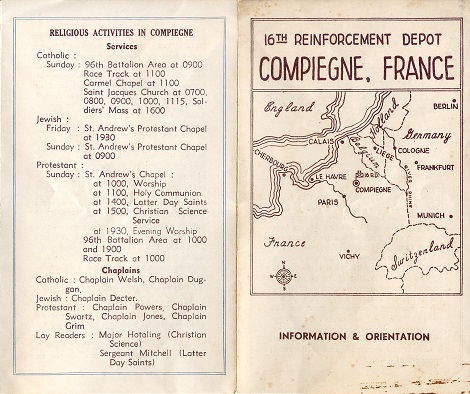
Front cover and schedule of worship services at the 16th Reinforcement Depot at Compiegne, France, 1944-45 (author’s collection).
.
.

Postcard from Chaplain School
It didn’t take long until the permanent Chaplain School that was reestablished to handle the influx of chaplains during WW2 outgrew its capacity at Fort Benjamin Harrison and moved to Harvard University where it remained until nearly the end of the war.
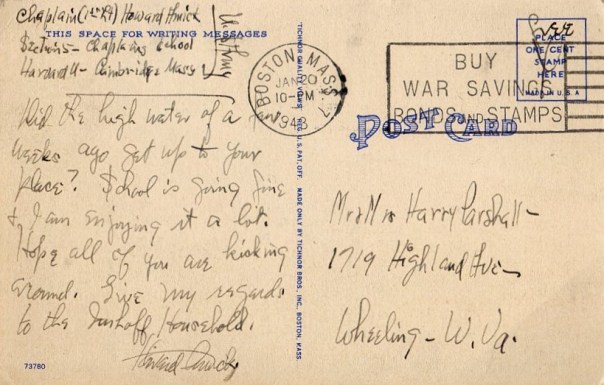
At least one chaplain-in-training enjoyed his time at the Chaplain School at Harvard, according to a postcard he sent to friends in West Virginia in January 1943. On the postcard he writes:
Chaplain (1st Lt) Howard Amick; Section 5-Chaplains School; Harvard- Cambridge Mass
Did the high water of a few weeks ago get up to your place? School is going fine & I am enjoying it a lot. Hope all of you are kicking around. Give my regards to the Imhoff Household.
Howard Amick
By necessity, postcards are brief, but it’s interesting to see one written by a student who in just a few weeks may be a chaplain ministering to soldiers in combat. However, at least initially Chaplain Amick was assigned to the 17th Infantry Training Battalion at Camp Wheeler, Georgia. He entered the chaplaincy after pastoring Warwood Lutheran Church in Wheeling, West Virginia.
Here’s the original postcard:

.
.

Happy 243rd Anniversary!
The Army Chaplain Corps celebrates its 243rd anniversary on 29 July 2018. Here’s a short video celebrating where they have gone and what they have done:
Happy Anniversary to the United States Army Chaplain Corps!
.
.

A WW2 Chaplain’s Letter from War
In our modern wars, service members are more likely to send an e-mail, video chat or even have a cell phone to talk with family back home rather than send a letter, but back before today’s technology, families had to wait for handwritten letters to make it to the battlefield and home again before hearing from their loved ones.
 Often, the time taken to compose these letters created interesting combinations of thoughts that people at war experienced. This particular letter was written on 3 February 1945 by Chaplain Clarence W. Baldwin to a friend named Grace Byers who was living in Pasadena, California during the war.
In this interesting letter, Chaplain Baldwin talks a bit about the assignments he had already had during the war and how his current assignment takes him all around England and into London many times. He wrote about some “food for thought” from a gentleman named Clifton, that Grace had included in one of her letters. He later develops that “food” into a sermon outline for future use with his soldiers. Chaplain Baldwin also describes to Grace how he enjoys receiving letters from home though he does not always have time to answer, but has a system to reply when he has time.
Disconcerting in this chaplain’s letter, however, is his confession that his work as a minister is “too hard” and that he is “thinking about giving it up when the war is over” questioning “who the chaplain is supposed to see when his morale is low.” Fortunately, though, things must have gotten better for Chaplain Baldwin as he continued in the ministry after the war, pastoring at least one church in Birmingham, Alabama in the 1950’s and 1960’s.
Here is a transcript of the letter, followed by a picture of the original v-mail Chaplain Baldwin mailed to Grace:
Dear Grace:
It was very nice of you to write to me. I enjoyed your Christmas card, the letter and the enclosure of ‘Clifton’s’. He does have a nice idea and the ‘food for thot’ [sic] is very appropriate.
So you like California? I do not blame you at all. After being over here I like everything about the USA. The weather is perpetually poor over on this side of the world and there is no place to go to find the kind of weather you like as we do back home. We can’t do as you have done [and] go to California or to Florida.
You notice that my address has changed again. I really get around. I have been in the Infantry, Medics, Ordinance and now I have a supervising job as District Chaplain. This work entails a great deal of traveling and I am seeing England at government expense. I get into London often and find myself better acquainted with that city than I am of most cities back home.
I hear regularly from home. Sis writes to me very often and I do not always find time to answer her. You will excuse my tardy reply to your letter. I always relish the idea of getting letters and most always answer them even though I may not do so very soon. I keep a file of unanswered letters and when I have a day off as I do today I get busy and answer many of them. There is no use for me to go anyplace on my day off. It would be too much like the proverbial Busman’s Holiday.
I just now stopped writing this letter to read again the ‘Food for Thot’ [sic] and I find at least one good sermon in the material. I think I shall call it ‘This is the Time and the Place.’ The material suggests that yesterday was mine, tomorrow will be mine but today is mine. The other two belong to God. Also, another bit in this paper suggests that we should not look at the grass in other person’s yard to our own opportunities wherever you are. [sic] Time and place, today and here. It should work out don’t you think? I could use the text ‘Do not be anxious about tomorrow’ which should be appropriate.
Some of these times I will let you know how the men like it. Already I have an illustration to pop into my mind. Always the preacher. Walking around the streets building sermons – day dreaming and what not. Seriously though, I am thinking about giving it up when the war is over. Believe me it is too hard, I know. A ministers life is very difficult. Always thinking about sermon material, programs, attendance, sick calls, problems, problems, problems. The other person never realizes that you may have a problem of your own. So they continue to pile them up on your shoulders. I have often wondered who the chaplain is supposed to see when his morale is low. It is, in a way a lonely life. Well, now you know, the chaplain comes to you.
Love, Clarence
.
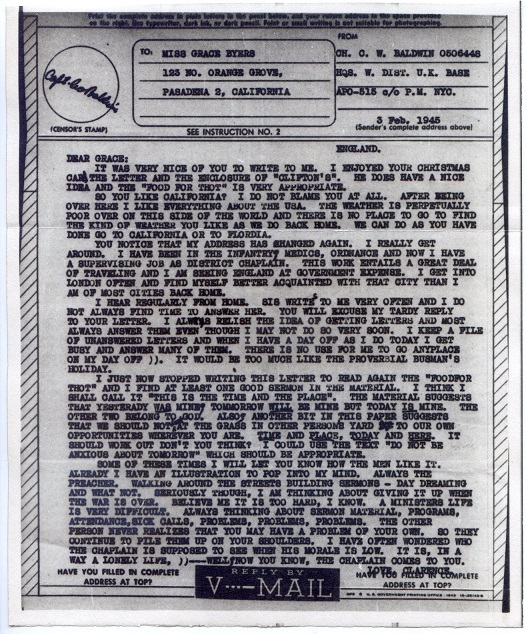
V-mail letter from Chaplain Clarence W. Baldwin to Grace Byers from England, 3 February 1945 (author’s collection).
.
.

Soldiers of God
The U.S. Army Chaplain Corps March was first performed by Bing Crosby on Easter in 1944. While many may be familiar with the chorus, there are also verses to the song you may not know. Enjoy Bing singing Soldiers of God with prints from the Chaplain Corps series’ History of the Chaplaincy and Chaplain Activities.
.
.

Army Chaplain School
Army Chaplain School to Celebrate Centennial in July
Army chaplaincy has much to celebrate in 2018 – the 243rd birthday of the Army Chaplain Corps and the 100 year anniversary of the Army Chaplain School.
The saying goes, “There are no atheists in foxholes.” While the veracity of that saying is
up for debate, one thing is true: if a Soldier is in a foxhole, there is an Army chaplain and
religious affairs specialist close by.

Chaplain (LTC) Glenn Palmer with RAS in AIT at Ft. Jackson, 22 May 2018 (USACHCS photo)
On July 20, the Army Chaplaincy will converge on Columbia, South Carolina, to hold the Centennial Celebration of the Army Chaplain School and to recognize the Army Chaplain Corps 243 Years of service.
The event will be held at the University of South Carolina Alumni Center, 900 Senate
Street, Columbia, South Carolina. All are welcome. For ticket information visit
https://www.eventbrite.com/o/united-states-army-chaplain-center-and-school-17341728260. This will be an evening of fun and inspiration as we celebrate the 100th Anniversary of the Army Chaplain School by “Looking back … launching forward,” said Chap. (Col.) Jeffery D. Hawkins, commandant of the U.S. Army Chaplaincy Center and School.
For 243 Years just as the Army itself, chaplains have served to “bring God to Soldiers and Soldiers to God.”
It was Continental Army Commander, Gen. George Washing- ton who is credited with saying, “We need chaplains.” And on his request to the Continental Congress, chaplains were established as part of the Army on July 25, 1775.
Army chaplains have stood alongside America’s fighting men and women during all of our wars. Some are buried in Arlington National Cemetery and cemeteries across the country. On the campus of the U.S. Army Chaplain Center and School at Fort Jackson is a memorial garden with the names of chaplains and religious affairs specialist wars, conflicts and attacks on our homeland.
Eight have been awarded the Medal of Honor: Chap. John Whitehead, Civil War; Chap. Francis B. Hall, Civil War; 1st. Lt. James Hill, Civil War; Chap. Milton L. Haney, Civil War; Calvin P. Titus, Battle of Peking; Chap. (Capt.) Emil J. Kapaun, Korea; Chap. (Maj.) Charles J. Watters, Vietnam; Chap. (Capt.) Angelo J. Liteky, Vietnam.
The Army Chief of Chaplains, Chap. (Maj. Gen.) Paul Hurley has charged Army chaplains to “Live the Call Fiercely” as they go out among units to carry out their duties to nurture the living, care for the wounded and honor the fallen.
The importance of chaplains in the Army was fully realized with the establishment of the Army
Chaplain School.
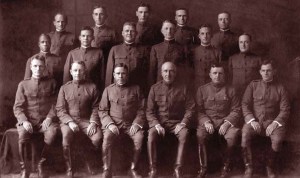
A photo of one of the first class of graduates from the Army Chaplain School, then located at Camp Grant, Illinois, 1920 (USACHCS photo).
The U.S. Army Chaplain School’s first session began March 3, 1918, to orient civilian clergymen to Army life. Originally located at Fort Monroe, Virginia, the five-week course consisted of military law, international law, Army regulations, service customs, hygiene, first aid and horsemanship. Chap. (Maj.) Aldred A. Pruden was appointed as the school’s first commandant. USACHCS re-located to Fort Jackson, South Carolina in 1996.
“Here at USACHCS we are ‘Shaping servant leaders … of unmatched character, competence and
connection … for God and country,’” Hawkins said.
The USACHCS trains chaplains and religious affairs specialists/NCOs to provide religious support to America’s Army and their families while assisting commanders in ensuring the right of free exercise of religion for all Soldiers.
Over 20 courses are offered to the chaplains and the religious affairs specialists/NCOs to
include the Chaplain Officer Basic Leader Course, residence and non-residence Chaplain
Captain Career Course, Brigade Chaplain Course, Advanced Individual Training and the Lieutenant Colonel Course. Functional Courses include the Resource Manager Course and the Fund Clerk Course.
In 2017, 1390 chaplains, chaplain candidates and religious affairs specialists received instruction in a variety of courses. The different components represented are: 477 active duty, 361 National Guard, 551 Reserve and 1 international student.
The religious affairs specialist also helps ensure a Soldier’s spiritual wellness is taken care of.
Religious affairs specialist training began as the Enlisted Assistant Basic Course in
1950 at the Chaplain School then located at Carlisle Barracks, Pennsylvania. In 1996, the U.S.
Army Chaplain Center and School, including both officer and enlisted courses, moved to its present home at Fort Jackson, South Carolina.
Together, the chaplain and religious affairs specialist make up the Unit Ministry Team. The UMT provides religious sup- port and advice to the commander. It is the duty and responsibility of the religious affairs specialist along with their Chap- lain to tend to the spirit of each Soldier. While the chaplain is a non-combatant, the religious affairs specialist is responsible for the security of the team, and is fully trained in Soldier tasks and religious support matters.
Today, there are chaplains and religious affairs specialists serving the Army in active duty, Reserve and National Guard units around the world.
.
.
Article data: written by Mel Slater, Army Chaplain Center and School Public Affairs. Article and photos first appeared in the Fort Jackson Leader, 4 July 2018, pgs. 6 & 20. Accessed 5 July 2018.
.




 The Chaplain Kit